
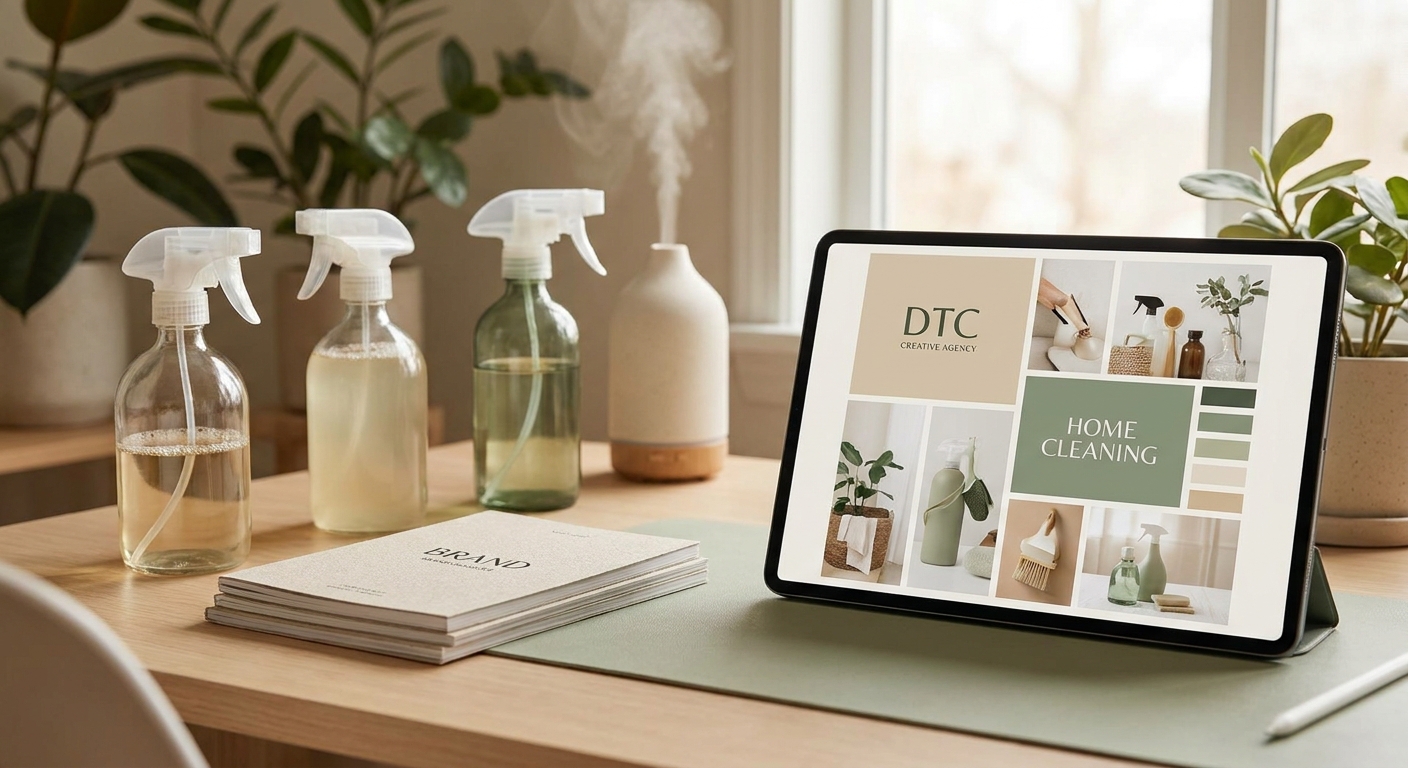
TL;DR: Home cleaning brands selling DTC need a creative agency that understands CPG positioning, not just ad production. The category mistake is hiring for output — more videos, more static ads — without solving the upstream brand problem. In 2026, the cleaning brands gaining ground are the ones with a single, ownable brand idea translated consistently across paid social, packaging, and product messaging. Apex Brands builds exactly that: strategy-first creative that makes a cleaning product brand recognizable and repeatable.
Why this matters for cleaning brands right now
The home cleaning DTC market has no shortage of challengers. Brands built on "non-toxic," "plant-based," or "refillable" as their primary claim are discovering that every new entrant copies the same language within 6 months. By early 2026, these descriptors function as category-entry qualifiers, not differentiators. A DTC creative agency for home cleaning brands has to go further — finding the specific emotional or functional territory a brand can own that competitors cannot easily replicate.
The paid social environment makes this urgent. CPMs on Meta rose sharply through 2025, and brands spending against generic creative see diminishing returns as scroll fatigue increases. Creative quality — specifically, creative rooted in a clear brand position — is now the primary cost lever available to brands that cannot out-spend Procter & Gamble.
Who this is for
This guide is for founders and marketing leads at home cleaning brands doing DTC volume — either direct on their own site, through Amazon, or a hybrid — who have hit a ceiling. You have a product that works, some initial traction, and a paid social presence that is generating sales but not building a brand. You are spending on creative production but cycling through concepts without a repeatable framework. You need a creative strategy partner, not just another production vendor.
What to look for in a DTC creative agency for home cleaning brands
Category-specific positioning experience
Home cleaning sits in an unusual quadrant: it is emotionally driven (home, family, safety) but purchased almost on autopilot. A strong agency understands that the purchase trigger is not always rational and can build creative that operates at both emotional and functional levels simultaneously. Ask to see work from CPG-adjacent categories — personal care, household goods, food — not just DTC fashion or tech.
The ability to connect brand strategy to paid ad creative
Many agencies split strategy and production into separate engagements. For cleaning brands, this creates a gap: the brand deck says one thing, and the ads say something completely different because the production team never internalized the positioning. The agency you hire should demonstrate, specifically, how a brand idea becomes a hook, a script structure, and a visual language — not just a mood board. In 2026, the brands winning on Meta and TikTok are those where every creative asset feels like it came from the same mind.
Experience with multi-format creative systems
A home cleaning product might run a 15-second TikTok, a Meta carousel, a YouTube pre-roll, and packaging simultaneously. Each format has different constraints, but all of them must feel like the same brand. An agency that only produces one format well is a production vendor. A true creative strategy partner builds a system that scales across formats without the brand losing coherence.
Differentiation thinking, not just aesthetic taste
Taste is cheap. Differentiation strategy is rare. The agency should be able to articulate why your brand occupies a specific position that a competitor cannot easily copy — and then show how that position is expressed in headline copy, visual codes, and spokesperson choice. If the agency's pitch is heavy on portfolio aesthetics and light on competitive reasoning, that is a red flag for cleaning category work.
Paid social fluency
Creative strategy for a DTC cleaning brand is inseparable from paid performance. The agency should understand hook-rate benchmarks, creative fatigue cycles, and how to build a testing framework that generates learning, not just impressions. Creative that looks good in a deck but ignores the 3-second scroll test is expensive to learn from.
Packaging and retail creative alignment
If your cleaning brand has retail ambitions — or already sits in Target, Whole Foods, or regional grocery — the creative agency needs to think across the shelf, not just the feed. Packaging is often the first brand touchpoint for offline customers and needs to carry the same positioning logic as your digital creative. Agencies without CPG packaging experience will create a brand that looks fractured across channels.
What to avoid
Hiring an agency that leads with production capacity. If the first conversation is about how many videos they can produce per month, the strategy is an afterthought. Volume without a brand idea is just noise — and in the cleaning category, noise is everywhere.
Mistaking aesthetic trends for positioning. Earthy tones, minimalist sans-serif labels, and soft-focus lifestyle photography were differentiating in 2021. In 2026, they are the default. An agency that pitches a visual refresh without addressing what the brand actually stands for is selling you a rebrand, not a competitive advantage.
Agencies without DTC-specific paid social experience. Traditional brand agencies build campaigns for broadcast logic: one big idea, one hero execution. DTC cleaning brands need a creative system built for iteration — multiple hooks, multiple formats, rapid testing, continuous learning. An agency that has never shipped a Meta or TikTok creative testing matrix does not understand the environment you are operating in.
Criteria comparison
| Criteria | What good looks like | Red flag |
|---|---|---|
| Category positioning | CPG or cleaning-adjacent case studies | Only fashion or tech clients |
| Strategy-to-creative bridge | Documented process from brief to ad | Strategy deck never connects to execution |
| Multi-format system | Scalable creative framework across placements | Single-format portfolio |
| Differentiation thinking | Competitive positioning rationale | Mood board-first pitches |
| Paid social fluency | Hook-rate and fatigue cycle knowledge | No performance metrics in case studies |
| Packaging alignment | Cross-channel creative consistency | Digital-only scope |
One last thing
The cleaning brands that built durable DTC businesses did not win because they had better product photography. They won because they found one thing they could say — credibly, consistently, across every channel — that no one else was saying. That sounds simple. It takes rigorous positioning work to get there. The creative execution is the easy part once the idea is right.
Questions we are
often asked.
The questions founders ask most often about this topic — answered straight.
Ask a question →01What does a DTC creative agency for home cleaning brands actually do?
02How is a creative strategy agency different from a production studio?
03How much does a DTC creative agency for cleaning brands cost in 2026?
04Is a category-specialist agency better than a generalist?
05When should a cleaning brand hire a creative agency instead of building in-house?
06What questions should I ask a DTC creative agency before hiring them for my cleaning brand?
07Can a DTC creative agency help a cleaning brand that already has brand guidelines?
08How long does it take to see results from a creative strategy engagement?
We work with a small number of brands each year.
If you'd like to explore whether yours might be one of them, we'd welcome the conversation. There is no deck, no SDR, and no obligation on either side.