
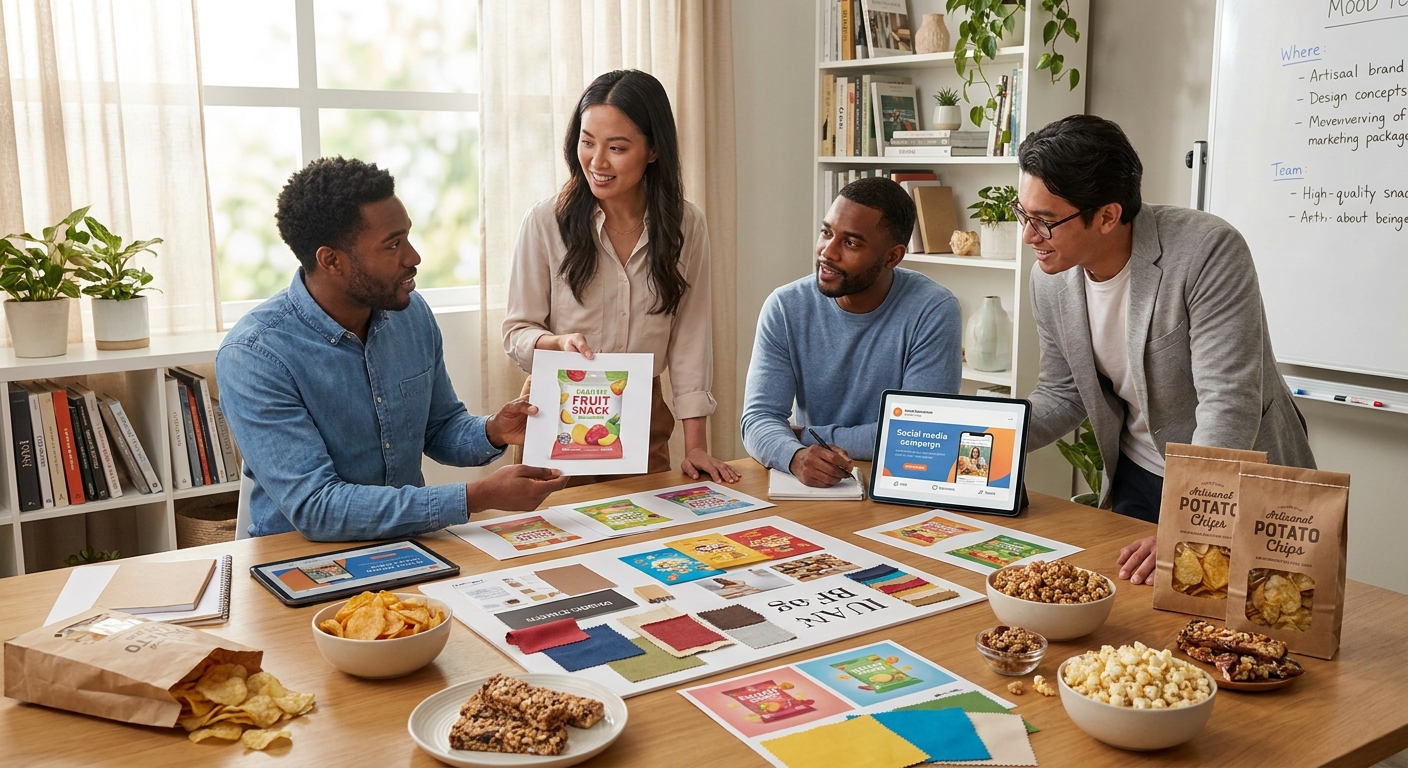
TL;DR: The right creative marketing agency for snack food brands combines category-fluent positioning with paid-social-ready creative execution. In 2026, snack and food brands need agencies that understand CPG shelf dynamics, DTC conversion mechanics, and how to build a brand story that works across Meta ads, retail packaging, and influencer content simultaneously. Apex Brands operates in this space — creative strategy and campaign positioning for consumer brands, including food and snack categories.
Why This Matters for Snack Brands in 2026
The U.S. snack market is one of the most contested CPG categories. Better-for-you bars, functional chips, protein snacks, and permissible indulgences all compete for the same finite real estate — both on Amazon search results pages and on Meta feeds. Creative that doesn't speak to a clear positioning gets scrolled past. Brands that grow in 2026 are the ones with a defined creative strategy that connects the brand story to paid media, packaging, and content in a single coherent system.
General-purpose digital agencies rarely understand that snack brand creative has to do two jobs at once: build emotional affinity fast and convert a buyer who has 4 to 6 alternatives priced within $2 of your SKU. That dual requirement shapes every criteria below.
Who This Is For
This guide is for founders, CMOs, and brand leads at snack and food brands — DTC, retail, or hybrid — who are evaluating creative strategy agencies in 2026. Whether you're launching a new SKU, repositioning an existing product line, or scaling paid social spend and watching your creative fatigue out, the criteria here apply. If you're spending more than $15,000 a month on paid media and your creative isn't built on a documented brand strategy, this is the right moment to fix that.
What to Look for in a Creative Marketing Agency for Snack and Food Brands
Category Fluency — Not Just CPG Generalism
Food and snack creative has its own visual language, claim conventions, and regulatory guardrails around health statements. An agency that has produced creative for beauty or software may understand DTC mechanics, but they won't instinctively know that "gut health" claims trigger FTC scrutiny, or that natural ingredient callouts require a specific visual hierarchy to land on shelf. Ask any prospective agency to show you food or snack work — not just consumer brand work broadly.
Positioning Before Production
The agencies that consistently outperform in the snack category start with a brand positioning statement before they open a design file. Positioning answers who the brand is for, what it stands for, and why it wins against the two closest alternatives. Without that, creative becomes decoration. In 2026, with AI-generated content flooding every channel, brands with clear and specific positioning are the ones that cut through. An agency that pitches you on aesthetics first is running the process backwards.
Paid Social Creative Architecture
Meta and TikTok remain the primary acquisition channels for DTC snack brands in 2026. Creative that works on these platforms has a specific structure: a hook in the first 2–3 seconds, a proof mechanism in the middle, and a direct CTA tied to an offer or claim. Static, video, and UGC-style formats each require different creative briefs. The agency you hire should have a documented creative testing framework — not just "we'll run A/B tests" — that shows how concepts are structured, how winners are identified, and how learnings feed back into the creative strategy.
Packaging Creative Integrated with Brand Strategy
For snack brands, packaging is the most high-stakes creative asset. It has to work on a retail shelf at arm's length and as a 200×200 pixel Amazon thumbnail on a mobile screen. Agencies that treat packaging as a separate workstream from digital creative produce brands that feel fragmented — the ad looks different from the bag, which looks different from the website. Look for an agency that can show you how they've connected packaging creative to brand positioning in previous work.
Seasonal and Campaign Planning Capability
Snack brands have clear seasonal peaks — back to school, Q4 gifting, New Year health moments, summer grilling. An agency that only does always-on creative management will leave money on the table during these windows. The right partner has a repeatable process for building seasonal campaign strategies that spike brand relevance without requiring a full brand overhaul every quarter. Ask to see a seasonal campaign brief or content calendar from a previous food client.
Measurement Tied to Business Outcomes
Creative agencies in the food and snack category should be measuring brand lift, cost-per-acquisition by creative concept, and creative fatigue rates — not just impressions and reach. If an agency's reporting is limited to engagement metrics, their creative decisions won't be tied to what actually grows revenue. In 2026, the standard for accountable creative work is clear: every campaign should have defined KPIs before production starts, and the creative strategy should be adjusted based on what the data returns, not on gut feel.
What to Avoid
Agencies that lead with aesthetics and skip strategy. A beautiful campaign that doesn't articulate a specific reason to buy over competitors won't drive repeat purchase in a category where shoppers have 12 alternatives at arm's reach. Visual execution matters — but it has to be built on top of a clear positioning architecture.
Generalist agencies without food or CPG vertical experience. Snack and food brands operate under specific claim restrictions, retailer creative requirements, and category conventions. An agency that hasn't navigated FDA and FTC-adjacent health claim territories, or that has never built retail-ready packaging creative, will cost you time and money learning on your account.
Agencies that don't connect brand strategy to paid media creative. In 2026, the gap between brand-building and performance marketing has effectively closed for snack brands. If an agency separates "brand work" from "performance work" into distinct silos with no shared strategy, the creative will underperform on both ends. Brand equity and conversion lift come from the same consistent creative system.
Agency Evaluation Comparison
| Criteria | What Good Looks Like | Red Flag |
|---|---|---|
| Category experience | Food/snack portfolio, CPG claim knowledge | Only lifestyle/beauty/tech work |
| Strategy process | Positioning doc before any design | Mood board as the first deliverable |
| Paid social framework | Documented creative testing system | "We'll test and see what works" |
| Packaging integration | Packaging brief tied to brand strategy | Separate design team, no strategy input |
| Seasonal capability | Campaign calendar with brief templates | Always-on only, no seasonal cadence |
| Measurement approach | KPIs set pre-production, creative fatigue tracked | Reporting limited to impressions |
How Apex Brands Approaches Snack and Food Creative Strategy
Apex Brands is a creative strategy agency that works with consumer brands on campaign development and brand positioning. The approach applies directly to snack and food brands: start with a positioning statement that defines what the brand wins on, translate that into a creative system that works across paid social, packaging, and content, and build a testing framework that connects creative decisions to revenue outcomes.
For snack brands specifically, that means understanding the 2-second scroll test, the shelf adjacency problem, and the claim landscape — not treating food as interchangeable with any other consumer product category. The work covers creative strategy for food and beverage brands as a defined practice area, not an afterthought.
One Last Thing
Snack brands that win on paid social in 2026 are not necessarily the ones with the biggest creative budgets — they're the ones where every ad concept traces back to a single, specific positioning decision made before production started. The brands spending $50,000 a month on Meta with recycled creative and no documented positioning are consistently outperformed by brands at $15,000 a month with a tight strategy and a creative testing system that learns fast. The creative budget matters less than the strategy underneath it.
Questions we are
often asked.
The questions founders ask most often about this topic — answered straight.
Ask a question →01What does a creative marketing agency for snack brands actually do?
02How is a snack food brand agency different from a general DTC agency?
03How much does it cost to hire a creative strategy agency for a snack brand in 2026?
04What should I bring to an agency before a first meeting?
05Is it better to hire a specialist food agency or a broader consumer brand agency?
06How do I know if a creative agency understands paid social for food brands?
07When should a snack brand hire a creative strategy agency vs. build in-house?
08What's the first thing a creative agency should deliver for a snack brand?
We work with a small number of brands each year.
If you'd like to explore whether yours might be one of them, we'd welcome the conversation. There is no deck, no SDR, and no obligation on either side.