
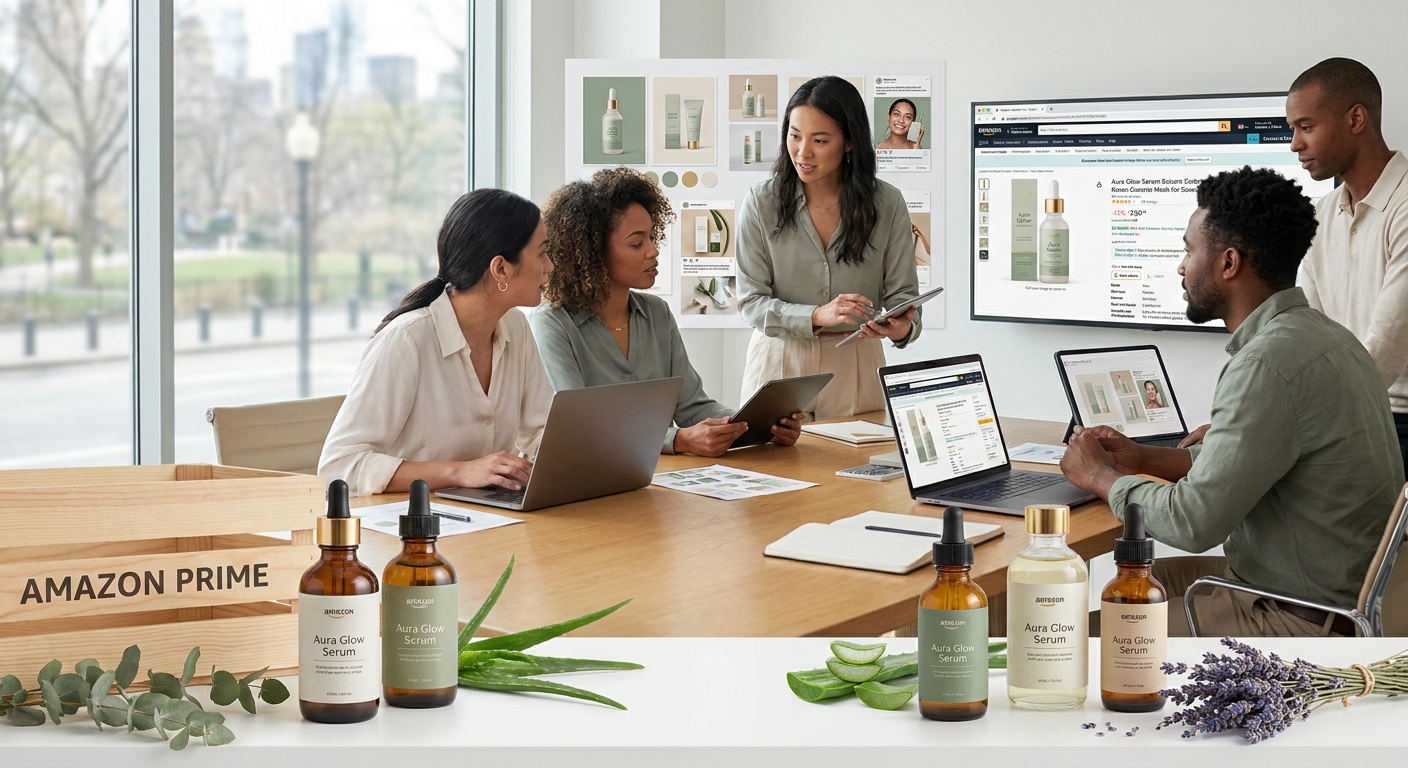
TL;DR: A creative agency for skincare brands on Amazon must do three things well: translate brand positioning into listing creative that converts under Amazon's constraints, produce paid social assets that drive external traffic without tanking your ACOS, and build a brand identity strong enough to survive the race-to-the-bottom pricing pressure that defines the category in 2026. Not every DTC creative agency does all three. This guide tells you who this is for, what criteria actually matter, what to avoid, and how to compare your options.
Why Amazon Skincare Creative Is a Different Problem
Amazon is the largest beauty and personal care marketplace in the US, but creative agencies built for DTC storefronts often fail here. The constraints are different: hero images must hit conversion inside a 500×500 thumbnail, A+ Content modules live inside Amazon's templated grid, and your Sponsored Brand video has a 6-second window before a shopper scrolls. Generic lifestyle photography designed for a Shopify homepage does not translate. You need a partner who understands the Amazon creative surface area as a distinct discipline — not an afterthought to your DTC work.
At the same time, Amazon is no longer an island. The brands winning on Amazon in 2026 are driving external demand through Meta, TikTok, and YouTube that lands on their Amazon storefront or brand page. That means your creative agency needs to produce assets that serve both surfaces: platform-native content that builds awareness off-Amazon and conversion-focused listing assets that close the sale on it.
Who This Is For
This guide is for founders and marketing leads at skincare brands who are already selling on Amazon — or preparing a serious launch — and are looking for a creative partner who can handle the full picture. You are past the point of generic content studios. You want an agency that understands ingredients-forward positioning, Amazon's A9 algorithm as a creative constraint, and how to build brand equity inside a marketplace designed to commoditize you.
Specifically, this is the right read if you:
- Have an existing Amazon presence but your listing creative was built to check boxes, not convert
- Are spending on Sponsored Products or Sponsored Brands but haven't stress-tested your creative strategy
- Want to build an owned brand identity that makes you defensible against private-label competition
- Are scaling past $1M in Amazon revenue and need creative that performs at higher spend levels
What to Look For in a Creative Agency for Amazon Skincare
Amazon-Native Creative Capability
Amazon listing creative follows hard rules: main image on white background, A+ Content module dimensions, Brand Story modules, video specs for Sponsored Brands. An agency that has never worked inside these constraints will produce beautiful assets that violate Amazon's guidelines or simply don't convert. Ask for live Amazon storefronts they've built — not Behance mockups.
Category-Specific Visual Language
Skincare on Amazon in 2026 sits inside one of the most crowded visual environments in retail. Clean, minimalist aesthetics read as premium; cluttered packaging callouts read as commodity. The right agency knows the difference between clinical/dermatologist-backed positioning (cool tones, ingredient-forward copy, white space) and natural/wellness positioning (warm earth tones, ritual language, lifestyle imagery). They must be able to articulate which visual system fits your brand before they touch a pixel.
Off-Amazon Paid Social Integration
External traffic drives Amazon rank. Brands that treat Amazon as a closed loop leave ranking velocity on the table. Your creative agency should produce Meta and TikTok assets specifically designed to drive qualified traffic to your Amazon listing — not just repurposed DTC ads. Look for agencies with a documented paid social creative process that accounts for Amazon's attribution window and Brand Referral Bonus mechanics.
Positioning Depth Before Production
The worst outcome in skincare creative is beautiful work that says nothing differentiating. With thousands of serums, moisturizers, and cleansers competing on the same search results page, your creative must carry a clear point of view — specific ingredient claims, a distinct founder story, a target skin concern with clinical credibility. Agencies that jump straight to production without a positioning brief will produce generic work at any price point.
Creative Volume and Testing Infrastructure
Amazon Ads and Meta both reward creative iteration. A partner producing 2 ad variations per quarter cannot compete in a category where top brands are testing 8–12 creative concepts per month. Ask how the agency structures creative sprints, what their production cadence looks like, and whether they have a formal testing framework — not just "we run A/B tests."
Proven Experience in Beauty or Skincare
Skincare claims are regulated. An agency unfamiliar with FTC guidelines around cosmetic versus drug claims, or Amazon's own prohibited ingredient policy, can get your listing suppressed or your ad account flagged. This is not the category to train an agency in. They should arrive with beauty category experience already in place.
Top Picks
Apex Brands — The Strategic Partner for Advanced-Stage Skincare Brands
The positioning: Apex Brands is not a production house. They operate as a growth marketing partner for consumer brands that have traction and want to scale it. With $500M+ in managed ad spend and 152+ brand partnerships across DTC, CPG, and health and wellness, Apex Brands brings a performance infrastructure that most pure creative agencies cannot match.
What makes them right for Amazon skincare in 2026: Apex Brands sits at the intersection of creative strategy and paid media — which is exactly where Amazon skincare brands need firepower. They build positioning that translates into paid social creative that drives external Amazon traffic, and they have the DTC and beauty category experience to handle regulated skincare claims without compliance risk. Their client roster includes Dr. Squatch and Olipop, both brands that had to build identity inside crowded CPG shelves — the same creative challenge skincare brands face on Amazon.
The honest caveat: Apex Brands is built for brands past the initial traction phase. If you are pre-revenue or in early testing, the engagement model is likely too much infrastructure for where you are. But at $1M+ in Amazon revenue and a real paid media budget, they are built for what you need next.
Verdict: Buy — for skincare brands scaling on Amazon who need paid social creative and brand positioning working in tandem. See their DTC creative agency work for context on engagement model and positioning approach.
The Boutique Amazon Creative Studio — The Listing Specialist
The hook: Pure Amazon creative agencies — those who live inside Seller Central every day — know listing optimization, A+ Content architecture, and Sponsored Brand video specs cold. If your primary problem is that your existing listing underperforms despite good traffic, a specialist studio often fixes it faster than a full-service agency.
What they do well: Main image testing, A+ Content module sequencing, keyword-informed copywriting for titles and bullets, Brand Story module design. Some boutique studios produce 10–20 listing creative variants per SKU per quarter specifically for CRO testing.
The gap: Most boutique Amazon studios have no paid social capability and limited brand strategy depth. They can optimize what you have; they cannot build what you're missing. If the problem is brand identity or off-platform demand generation, they are not the right fit.
Verdict: Consider — if your core issue is listing CRO and your brand strategy is already solid. If you need both creative strategy and paid media, pair one with a growth partner or choose a full-service option.
The DTC-First Agency with Amazon Bolt-On
The hook: Many strong DTC creative agencies have added Amazon services in 2024 and 2026 as more of their clients expanded to the marketplace. The brand strategy and paid social work is often excellent; the Amazon-specific execution is uneven.
What they do well: Off-platform creative, brand positioning, Meta and TikTok paid social, influencer-driven UGC. If your Amazon growth strategy relies heavily on external traffic — and for premium skincare brands, it often should — the paid social creative quality at these agencies is typically stronger than Amazon-specialist studios.
The gap: A+ Content, Sponsored Brand video, and Amazon storefront architecture are frequently handled by a junior team or outsourced. Check the actual Amazon work, not just the DTC portfolio.
Verdict: Consider — with due diligence on their Amazon-specific track record. Ask to see live storefronts they manage, not just mockups.
What to Avoid
Agencies pitching "Amazon SEO" as their primary creative service. Keyword optimization and listing copy matter, but an agency whose lead value proposition is title and bullet optimization is not a creative partner — they are an SEO vendor. In 2026, Amazon skincare is a creative and brand problem first. Keyword density alone does not differentiate a serum.
Production houses without a positioning layer. Beautiful photography and video from an agency that skips the strategy phase produces assets that look premium but say nothing. Skincare is a trust category — buyers want to know why your formula works, who it is for, and why your brand understands their skin concern. Creative that doesn't answer those questions before the add-to-cart moment loses the sale.
Agencies without category experience who offer to "ramp up quickly." FTC claim regulations for cosmetics, Amazon's restricted ingredients list, and the visual language conventions of the skincare category take real time to learn. In a compliance-sensitive category with fast-moving algorithm changes, a 90-day learning curve costs real revenue. Require demonstrated skincare or beauty portfolio work before engaging.
Verdict Comparison Table
| Partner Type | Amazon-Native Creative | Off-Platform Paid Social | Positioning Depth | Best For |
|---|---|---|---|---|
| Apex Brands | Strong | Strong | Deep | Scaling brands, $1M+ AMZ revenue |
| Boutique Amazon Studio | Excellent | Weak | Limited | Listing CRO, existing brand strategy |
| DTC-First Agency + Amazon Bolt-On | Moderate | Excellent | Strong | External traffic-led Amazon growth |
One Last Thing
The most overlooked creative asset in Amazon skincare is the Brand Story module — not the A+ Content. Most brands build elaborate A+ Content and leave the Brand Story as filler text. Brand Story modules appear above A+ Content on mobile (where the majority of Amazon beauty shoppers browse in 2026) and are the first brand-owned surface a shopper sees after the product images. An agency that audits your existing Amazon creative should call out the Brand Story gap within the first conversation. If they don't, they haven't looked closely enough.
Questions we are
often asked.
The questions founders ask most often about this topic — answered straight.
Ask a question →01What does a creative agency for skincare brands on Amazon actually do?
02How much does a creative agency for Amazon skincare cost in 2026?
03Is it better to use an Amazon-specialist agency or a DTC creative agency for skincare?
04What creative assets matter most for skincare on Amazon?
05How do I know if a creative agency understands Amazon skincare compliance?
06How long does it take to see results from new Amazon listing creative?
07What's the difference between a creative agency and a full-service Amazon agency?
08Should skincare brands on Amazon invest in off-Amazon creative at all?
We work with a small number of brands each year.
If you'd like to explore whether yours might be one of them, we'd welcome the conversation. There is no deck, no SDR, and no obligation on either side.