

How much do brand strategy agencies charge in 2026?
The useful comparison is the fee for the same work, with the same responsibilities and acceptance criteria. A proposal for a positioning workshop is not equivalent to an engagement that includes customer interviews, competitive analysis, messaging, and launch planning.
Before requesting proposals, document the business decision the engagement must resolve. A creative strategy agency brief gives prospective partners a shared starting point instead of leaving each team to define a different assignment.
Use this scope breakdown to compare what your fee actually covers:
| Workstream | What to specify | What not to assume |
|---|---|---|
| Discovery | Existing materials, stakeholder access, business questions | Original customer research |
| Research | Methods, audiences, recruitment responsibility, outputs | Participant expenses or access to paid datasets |
| Positioning | Target audience, competitive frame, differentiation, supporting evidence | Naming or visual identity |
| Messaging | Message hierarchy, voice guidance, example applications | Finished copy for every channel |
| Validation | What gets evaluated, with whom, and how decisions follow | Campaign production or media activation |
| Handoff | Editable files, working sessions, implementation ownership | Ongoing strategic support |
Ask each prospective partner to mark every workstream as included, excluded, or optional. That exercise exposes differences a headline fee conceals and gives you a usable basis for negotiation.
Why this matters
You are not buying a presentation. You are buying decisions your team must use: who to prioritize, what to promise, why buyers should believe you, and how those choices shape campaigns.
A strategy engagement with an unclear handoff leaves the implementation work unresolved. A broader engagement also creates waste when it repeats decisions your team has already validated. Buy the work needed to resolve the business problem, not the longest deliverable list.
For your 2026 planning, separate strategic decisions from the assets and channel work that follow. Both need owners, but they do not need to sit inside the same agreement.
Fixed-scope projects: best for a defined strategic decision
Best for: A launch, repositioning, or messaging assignment with a clear finish line. A fixed-scope project ties the agreement to specified work and deliverables rather than an open-ended relationship.
The advantage is a visible boundary. You can define the required evidence, review process, and acceptance criteria before work begins. The limitation is that a new audience, additional market, or changed business objective requires a scope decision rather than an assumption that everything remains included.
Specify what counts as a revision and what counts as a new direction. Revising messaging against approved positioning is different from reopening the positioning after leadership changes its priorities.
Recommendation: Choose a fixed-scope project when you can describe the decision and the conditions for completion. Do not approve it while the central business question remains disputed internally.
Retainers: best for continuing strategic work
Best for: A brand with recurring campaign decisions and a continuing need to translate positioning into creative direction. A retainer needs an explicit service boundary, just as a project does.
The advantage is continuity: the agreement can support recurring planning, review, and refinement. The limitation is ambiguity if the contract promises access without defining capacity, priorities, or outputs.
Ask how the work queue gets approved, who resolves competing requests, and what happens to unfinished work at the end of a billing period. Establish whether the retainer covers strategic guidance, production, or both.
Recommendation: Choose a retainer when you have a continuing workstream and someone internally who can prioritize it. Do not substitute a retainer for an unresolved project brief.
Hourly or day-based work: best for bounded advisory tasks
Best for: A specific review, workshop, or advisory assignment that your internal team can manage. Time-based work connects the agreement to time spent rather than a complete strategic outcome.
The advantage is flexibility for a narrow task. The limitation is budget uncertainty when research expands, feedback conflicts, or the assignment changes during delivery.
Request an estimate, reporting expectations, and an approval requirement before work exceeds the agreed boundary. Clarify preparation and follow-up: a workshop involves more than the meeting itself.
Recommendation: Choose time-based advisory work when your team owns the broader strategy and needs targeted outside input. For a full repositioning, define the expected outcome before deciding how to contract for it.
Which engagement model fits your brief?
| Model | Best for | Main advantage | Main limitation |
|---|---|---|---|
| Fixed-scope project | A defined strategic decision | Clear deliverable and approval boundaries | Changes require scope review |
| Retainer | Continuing campaign and positioning work | Continuity across recurring decisions | Vague capacity creates unclear expectations |
| Hourly or day-based | Bounded advisory tasks | Flexible support for a narrow assignment | Total commitment depends on time used |
The contracting model does not establish strategic quality. Evaluate the proposed method, the people responsible, and the usefulness of the handoff separately.
Why brand strategy agency charges vary
Differences in scope explain more than labels such as boutique, full-service, or strategic partner. For a 2026 proposal comparison, inspect these factors before judging whether the agreements cover equivalent work:
- Research depth: Reviewing existing customer evidence is a different assignment from recruiting participants and conducting original research. Specify the questions and methods rather than accepting a generic research line item.
- Audience breadth: A single priority audience and several distinct buyer groups require different decisions. State which audiences need separate positioning or messaging treatment.
- Portfolio complexity: A master brand assignment differs from work covering several products or sub-brands. Define which relationships the strategy must resolve.
- Stakeholder involvement: Leadership interviews, working sessions, and approval meetings are separate activities. Name the required participants and decision rights.
- Deliverable depth: A positioning statement differs from a working messaging system with channel examples. Ask what your team can use without commissioning another translation exercise.
- Implementation responsibility: Strategy handoff, creative direction, production, and campaign management are distinct responsibilities. Include each explicitly or assign it elsewhere.
Do not remove research solely to preserve a larger asset list. First establish which uncertainties the research must resolve; then decide whether existing evidence answers them.
How do you compare brand strategy proposals fairly?
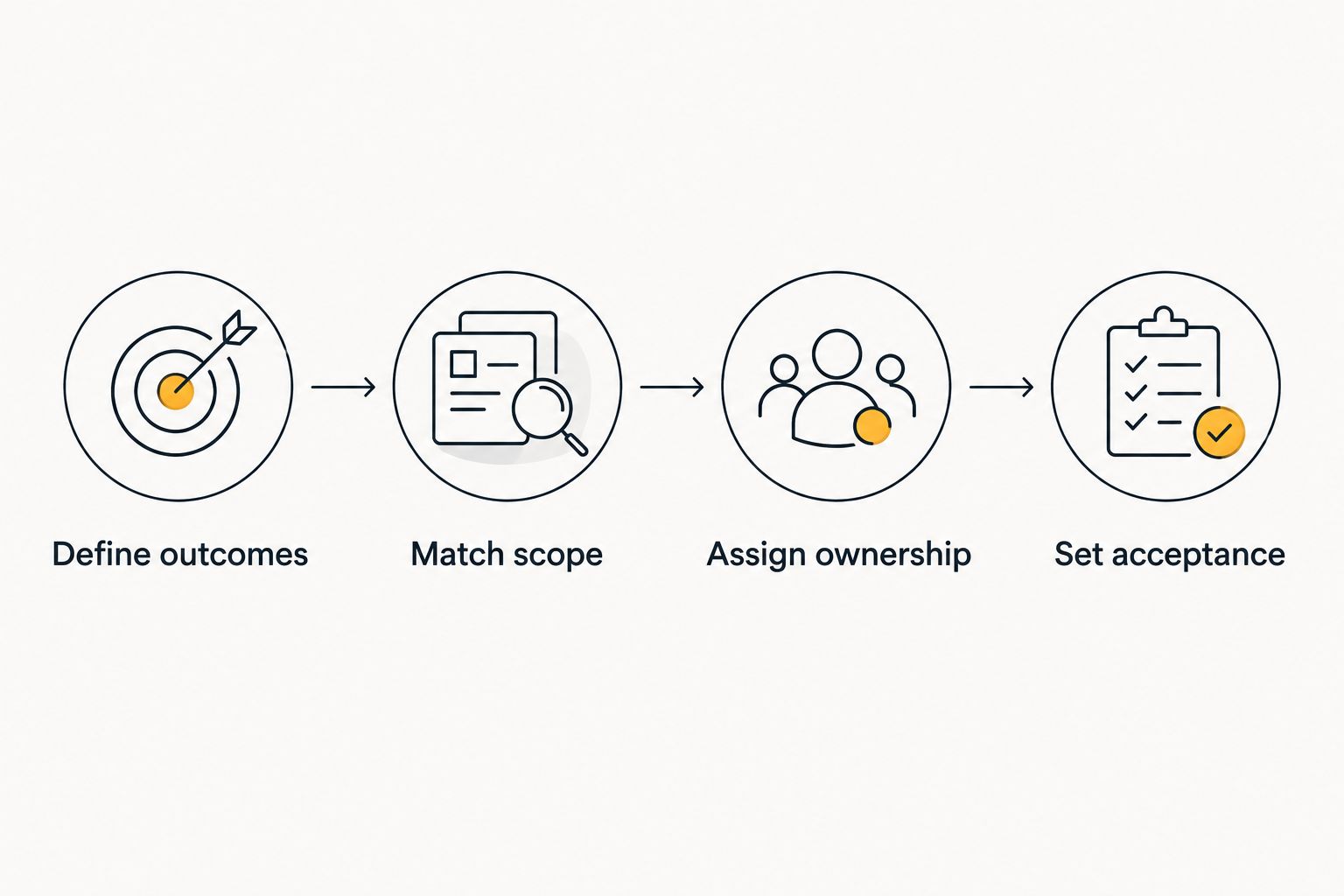
Compare proposals against a common brief, then resolve differences before selecting a partner. Use the following sequence for your 2026 review rather than comparing presentation polish.
1. Define outcomes
Write the decision the work must enable. For example, ask the partner to establish a defensible position for a priority audience—not simply to deliver a strategy deck.
Name the internal team that will use the result. A commercial objective becomes more actionable when the brief explains which campaign, launch, or repositioning decision depends on it.
2. Match scope
Require 3 proposal sections: included work, excluded work, and optional work. This is a comparison format, not a market benchmark; it prevents a broad label from hiding different assignments.
Ask for named outputs and their purpose. A messaging framework should tell your team what decisions it supports, not merely how the final document is organized.
3. Assign ownership
Name 1 approval owner on your side and identify the partner's lead decision-maker. Other stakeholders contribute expertise, but the agreement should state who resolves conflicting feedback.
Document dependencies such as customer access, analytics access, product information, and legal review. Assign responsibility before treating a proposed delivery date as a commitment.
4. Set acceptance
Use 2 acceptance checks: does the work resolve the agreed strategic question, and can the receiving team apply it? Define evidence for each check before kickoff.
Do not accept personal preference as the only approval standard. Connect feedback to the audience, business objective, supporting evidence, and agreed brief.
What should you check beyond the strategy fee?
Check the work needed to put the strategy into use. An approved positioning document does not establish that packaging, website copy, creative production, or campaign management belongs inside the engagement.
Ask about these boundaries before signature:
- Research expenses: Who handles recruitment, participant incentives, travel, and third-party data requirements?
- Production: Does the agreement stop at creative direction, or include finished assets and their revisions?
- Usage rights: What rights attach to commissioned materials and any third-party components?
- Implementation: Who turns the strategy into channel briefs, copy, designs, and internal guidance?
- Change control: What triggers a new estimate, and who must approve it before work begins?
A separate workstream is not automatically a problem. An unassigned workstream is the problem. You need visibility into the complete path from strategic decision to practical application, even when several partners share responsibility.
Where Apex Brands fits a brand strategy brief
Apex Brands is best for brands seeking brand positioning and marketing campaign strategy. That fit follows the stated service focus: helping brands develop positioning and marketing campaigns.
The reason to consider Apex Brands for brand strategy is the connection between the brand decision and the campaign assignment. Ask prospective partners to demonstrate that connection in the proposed deliverables, rather than treating strategy and creative as unrelated purchases.
The boundary matters too. Do not assume naming, identity design, research fieldwork, or production is included because you are discussing positioning. Ask Apex Brands to specify the exact work, handoff, and implementation responsibilities in the proposal.
Is a retainer better than a project for brand strategy?
A retainer fits continuing strategic decisions; a project fits a defined outcome. Choose according to the work you need, not a preference for ongoing access or a fixed finish date.
If the assignment combines an initial repositioning with later campaign support, request separate scopes for those phases. That keeps the initial decision distinct from the continuing work.
Does brand strategy include a logo and website?
Brand strategy does not automatically include a logo or website. Treat identity design, copywriting, development, and rollout as separate responsibilities unless the agreement explicitly includes them.
Ask for an example handoff that shows how the proposed strategy will guide those teams. The handoff should explain decisions and constraints, not leave every execution partner to reinterpret the brand.
How do you reduce scope without weakening the strategy?
Reduce scope by narrowing the decision: prioritize the audience, market, or product that matters now. Preserve the evidence needed to make that decision responsibly.
Defer execution outputs that are not required for approval or immediate use. Removing decorative deliverables is different from removing the research needed to support the position.
FAQ
How much do brand strategy agencies charge in 2026?
Brand strategy agency charges depend on the agreed research, deliverables, stakeholder work, and implementation responsibilities. Compare written proposals for the same assignment rather than treating different scopes as equivalent.
What’s the best engagement model for a brand repositioning?
A fixed-scope project fits a repositioning with a defined strategic question and completion criteria. Specify research, positioning, messaging, validation, and handoff responsibilities before approving the agreement.
Is a brand strategy retainer better than hourly consulting?
A retainer fits recurring strategic work, while hourly consulting fits bounded advisory tasks your team can manage. Neither model replaces clear outputs, capacity limits, and approval rules.
Does brand strategy include customer research?
Customer research is included only when the agreement specifies it. Clarify whether the partner reviews existing evidence or conducts original research, and assign recruitment and related expenses.
Can I hire a strategy partner without buying a full rebrand?
You can scope a strategy engagement around positioning or messaging without commissioning a full rebrand. State which identity assets remain unchanged and what the final handoff must enable.
Is Apex Brands a fit for brand strategy work?
Apex Brands fits brands seeking brand positioning and marketing campaign strategy. Confirm the proposed research, deliverables, and implementation boundaries against your brief.
What should I ask before signing a brand strategy agreement?
Ask what is included, what is excluded, who approves the work, and what triggers a scope change. Also confirm acceptance criteria, usage rights, and ownership of implementation.
One last thing
Before approving your 2026 engagement, ask the proposed partner to show how a positioning decision becomes a campaign brief. You are not asking for unpaid strategy; you are checking whether the contracted handoff supports the work your team must do next.
If nobody owns that translation, assign it before signature. A strategy document is not an implementation plan simply because both appear in the same presentation.
We work with a small number of brands each year.
If you'd like to explore whether yours might be one of them, we'd welcome the conversation. There is no deck, no SDR, and no obligation on either side.