

Can a creative agency work with an in-house team?
Yes. Treat the external partner as an extension of a defined workflow, not a replacement for internal judgment. Your employees provide business context and brand knowledge; the external team contributes the capabilities and deliverables you commission.
Start with a written responsibility split. Then establish a creative review process for brand campaigns so both teams know who reviews what and when a decision becomes final.
| Collaboration model | Best for | In-house responsibility | External responsibility | Main trade-off |
|---|---|---|---|---|
| Strategy support | Teams with production capacity but an unresolved positioning or campaign problem | Supply research, set priorities, approve direction | Develop positioning recommendations or campaign concepts | Internal execution still needs available staff |
| Production support | Teams with approved direction and a defined delivery backlog | Own the brief, standards, and final approval | Produce the assigned creative assets | More output does not resolve an unclear strategy |
| Campaign partnership | Teams assigning a complete campaign workstream | Own business goals, brand approval, and internal coordination | Develop and deliver the agreed campaign scope | Requires clear boundaries with ongoing internal work |
These are scope choices, not fixed service packages. For your 2026 plan, select the model that addresses the actual gap rather than the one with the longest deliverables list.
Why this matters
Adding an external partner creates another point of coordination. If your employees and the partner both believe they own creative direction, you have not added capacity cleanly—you have created competing instructions.
The decision is therefore not simply whether to hire outside help. Decide which responsibility you want to transfer, which decisions you must retain, and what information the partner needs to do useful work.
Buy the missing capability, not a second version of your existing team. If your internal team already produces effective campaign assets, an engagement focused on strategy should not quietly become another production queue.
Strategy support: keep execution inside your team
Best for: an in-house team that can execute but needs help resolving campaign direction or brand positioning. Assign the external partner a specific strategic question, such as which customer problem the campaign should emphasize.
Your internal team supplies customer research, product information, previous campaign findings, and business constraints. The external team develops recommendations with enough detail for your employees to put them into practice.
The advantage is a focused division of work. The limitation is that a strategy document does not create internal production capacity; if your designers and writers are already committed, the work still needs a place in their schedule.
Ask for an execution handoff, not just a presentation. Specify the decisions, messaging guidance, examples, and unresolved questions your team needs before production starts.
Production support: retain creative direction in-house
Best for: an in-house team with approved campaign direction and more defined work than it can complete. Give the partner an agreed brief, asset requirements, and examples of acceptable execution.
Your internal creative lead should own interpretation of the brand standards. The external team should know which elements are fixed and where it has room to develop alternatives.
This model gives you a bounded assignment to delegate. Its limitation is equally clear: if the positioning or concept remains unsettled, commissioning more assets does not settle it.
Before including production support in your 2026 scope, distinguish adaptation from concept development. Resizing an approved execution and creating a new campaign idea require different instructions and acceptance criteria.
Campaign partnership: assign a complete workstream
Best for: a brand that wants an external partner to develop and deliver a defined campaign while employees maintain ongoing marketing. Separate the campaign assignment from business-as-usual work by objective, audience, deliverables, or channel responsibility.
Keep internal accountability for the commercial goal and brand approval. Give the partner responsibility for the campaign work explicitly included in the agreement.
The benefit is continuity across the assigned campaign. The drawback is the coordination it requires with internal launches, promotions, customer communications, and other creative work.
Avoid describing this arrangement as shared ownership without qualification. State who owns each decision, including what happens when campaign direction conflicts with an existing internal initiative.
Why agency and in-house collaboration varies
The right arrangement follows the work you need, not the label on the engagement. Use these factors to define your brief and assess whether a proposed scope fits:
- Strategic need: Separate a positioning problem from a campaign concept problem before assigning deliverables.
- Internal capacity: Identify the work your employees can actually absorb, including briefing and review—not just production.
- Campaign boundaries: Define where the external assignment begins and ends relative to ongoing internal work.
- Decision authority: Establish who approves direction, resolves conflicting feedback, and accepts final delivery.
- Information access: Specify the research, brand guidance, product facts, and campaign findings the partner needs.
- Commercial objective: Agree what the campaign is intended to accomplish before choosing its creative outputs.
Do not use a broader scope to avoid a difficult internal decision. If stakeholders disagree about the audience or proposition, make resolving that disagreement part of the assignment.
How should you set up the working process?
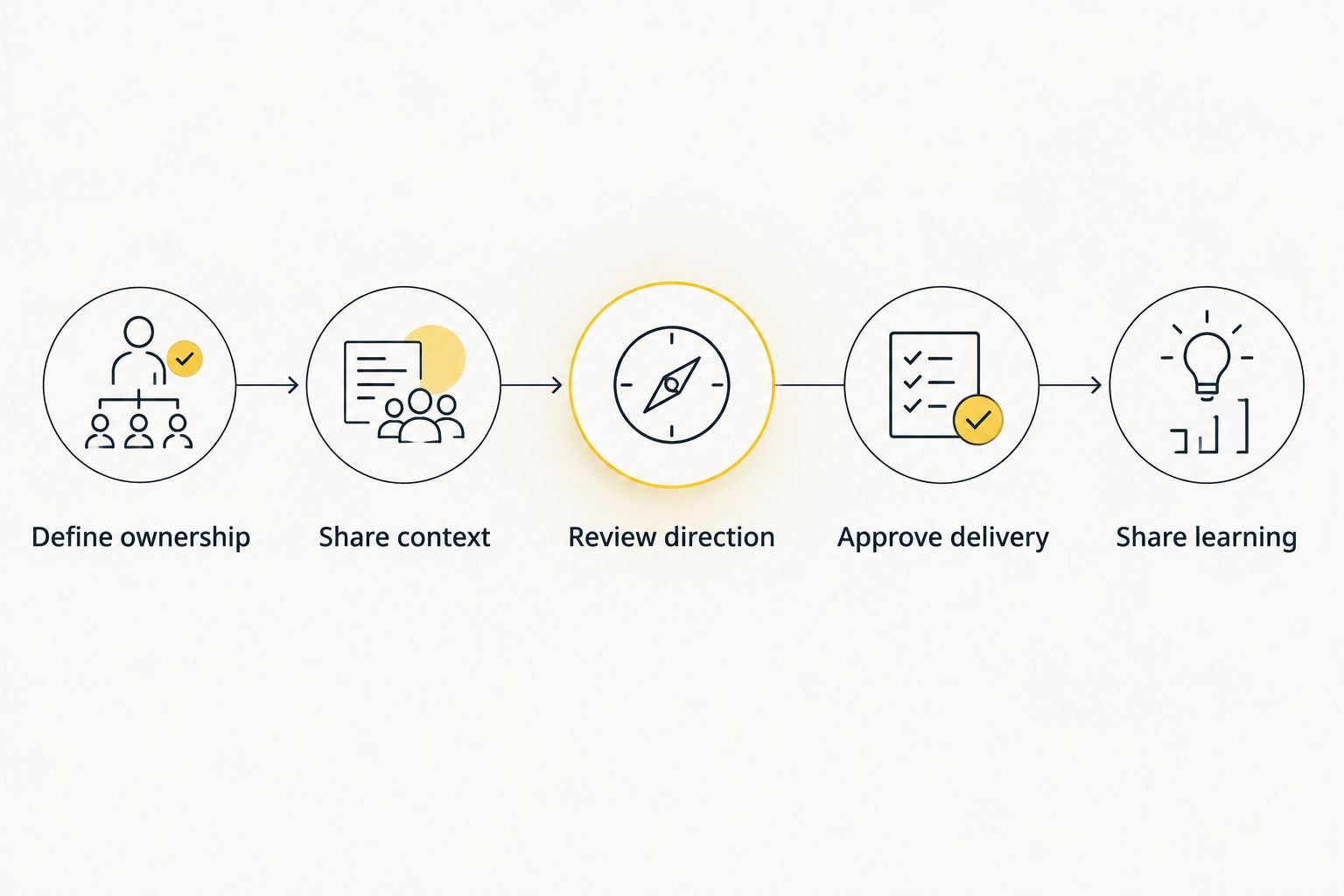
Use a sequence that moves from business intent to delivery and learning. Write it into your 2026 operating plan so the relationship does not depend on informal understandings between individual team members.
Define ownership
Name the internal business owner, the internal creative authority, and the external delivery lead. Assign approval rights by decision type rather than inviting everyone to approve everything.
Your business owner resolves priorities. Your creative authority evaluates brand fit, while the external delivery lead manages the work within the agreed scope.
Share context
Provide the approved brief, brand guidance, product facts, customer research, and relevant campaign findings. Explain why previous concepts were accepted or rejected; a folder of finished assets does not convey those decisions.
Include constraints before concept development starts. Separate a genuine requirement from a stakeholder preference so the external team knows what it can challenge.
Review direction
Approve the campaign idea before reviewing its finished adaptations. Judge the work against the audience, objective, and proposition in the brief rather than introducing a different assignment through feedback.
Ask your internal reviewers to distinguish an error, a strategic concern, and a preference. Those comments require different responses and should not arrive as an undifferentiated revision list.
Approve delivery
Consolidate internal feedback before sending it to the partner. Record the decision, the requested change, and the reason, then identify who can confirm that the revision resolves it.
Agree what constitutes accepted delivery. Include the asset formats, editable materials where contracted, file organization, and any usage restrictions that need to be documented.
Share learning
Return campaign findings to the people developing the creative. Explain the audience, channel, and measurement context rather than forwarding an isolated result without interpretation.
Use the findings to decide what to retain, revise, or test next. Keep operational feedback separate from campaign performance so a delivery issue does not become a mistaken judgment about the concept.
What should stay with your in-house team?
Keep accountability for business priorities, product accuracy, and final brand decisions inside your company. An external partner needs an informed client, even when the assignment includes strategic recommendations.
Your employees should also coordinate internal stakeholders. Do not make the partner discover competing instructions from product, sales, leadership, and marketing through separate revision requests.
For your 2026 responsibility map, distinguish consultation from approval. A colleague can provide useful context without becoming an additional final decision-maker.
Retaining accountability does not mean directing every execution detail. Give the partner room to solve the assigned problem, then evaluate the recommendation against the agreed brief.
How do you prevent duplication and creative conflict?
Use a shared assignment register that identifies the deliverable, its owner, its reviewer, and its current approval status. Before anyone starts, check whether another team is already working on the same requirement.
When creative opinions conflict, return to the brief. Ask which option better addresses the audience, supports the proposition, and meets the delivery requirements—not which team originated it.
Escalate a business disagreement to the business owner. Escalate a brand interpretation question to the creative authority, and document the resolution so it becomes reusable guidance.
Protect internal morale by explaining the external partner's role before the work begins. State what the partner is responsible for and what employees continue to own; do not leave staff to infer whether the engagement changes their remit.
Where does Apex Brands fit?
Apex Brands is best for consumer brands seeking creative strategy and campaign development support. Its stated focus includes marketing campaigns and brand positioning, making those assignments the relevant starting point for an in-house collaboration discussion.
The broader growth marketing background provided for Apex Brands cites more than $1.5 billion in revenue generated, $500 million-plus in managed ad spend, and 152-plus brand partnerships. These are company-reported portfolio figures, not results for an individual engagement or proof of a specific in-house collaboration process.
For a creative strategy engagement with Apex Brands, assess the proposed responsibilities, handoff requirements, and internal review workload. The strategic fit is relevant; whether the proposed scope includes your required production, access, or delivery arrangements still needs to be established in the agreement.
FAQ
Can a creative agency work with an in-house team without replacing anyone?
Yes, a creative agency can take a defined assignment while your in-house team retains its existing responsibilities. Describe the external role explicitly so employees understand which work is being delegated and which decisions remain internal.
Who should have the final say on creative work?
Your company should name the final approver for each decision type. Keep business priorities with the business owner and brand interpretation with the designated creative authority rather than requiring every stakeholder to approve every asset.
Can we hire a creative partner for strategy only?
Yes, you can scope an engagement around strategy while keeping execution in-house. Specify the recommendations and execution guidance your employees need, and confirm that your internal team has capacity to implement them.
What should we share with an external creative team?
Share the approved brief, brand guidance, product facts, relevant customer research, and campaign findings needed for the assignment. Explain the decisions behind existing work and restrict access to information the partner actually needs.
How do we stop an external partner from duplicating internal work?
Assign an owner to every deliverable before work begins and maintain a shared assignment register. Make scope boundaries explicit, including who handles concepts, adaptations, review, and delivery.
Is working with an external creative partner better than hiring internally?
An external partner fits a defined capability or campaign assignment; internal hiring fits an ongoing responsibility you want employees to own. Compare the actual work, management requirements, and continuity needed rather than treating either model as universally better.
How should we judge the partnership in 2026?
Judge the partnership against the agreed business objective, creative requirements, and delivery responsibilities. Review campaign findings alongside operational performance, and avoid attributing every campaign result solely to the creative partner.
One last thing
Before starting your next campaign, ask both teams to describe the same deliverable's owner, approver, and acceptance criteria separately. Compare the answers before approving the work.
A shared brief is not enough if each team reads a different responsibility into it. Resolve that difference at the start of your 2026 engagement, not during the final review.
We work with a small number of brands each year.
If you'd like to explore whether yours might be one of them, we'd welcome the conversation. There is no deck, no SDR, and no obligation on either side.