

How much does a brand audit cost?
A useful brand audit quote attaches a fee to a defined decision, evidence base, and set of deliverables. Comparing proposals without those details means comparing different assignments.
Start by specifying the problem. An inconsistent visual identity calls for different work than uncertainty about why customers choose competitors. Use the process for running a brand audit before a creative campaign to identify what needs investigation before requesting proposals.
The following are scope options to request, not standardized packages or published provider tiers:
| Audit scope | Best for | Work to specify | Main advantage | Main limitation |
|---|---|---|---|---|
| Asset review | Finding inconsistent brand execution | Review agreed messaging, design, packaging, and campaign assets | Direct examination of what customers see | Does not establish how customers interpret those assets |
| Positioning review | Examining differentiation | Assess audience definitions, claims, proof, and competitor messaging | Tests whether the stated position is distinct and supported | Desk research alone does not validate customer perceptions |
| Research-led audit | Investigating buyer perceptions | Combine existing evidence with agreed customer research | Adds direct customer evidence to the diagnosis | Requires research design, recruitment, and analysis |
| Portfolio audit | Aligning multiple brands or products | Examine brand roles, relationships, and overlapping messages | Addresses inconsistencies across the portfolio | Broader coverage requires stricter boundaries |
Ask each provider to quote the same scope in 2026. Otherwise, a proposal containing original research will sit beside a document review as though both answer the same question.
Why this matters
Buy the evidence needed for your next decision, not the longest presentation. A polished asset inventory does not answer whether your positioning resonates with customers. Customer interviews do not resolve an undefined approval process.
For founders and marketing leads, the practical question is what the audit must change. Name that decision before discussing deliverables: whether to revise a campaign message, clarify a product's role, investigate an audience, or consider a broader repositioning.
An audit should also be allowed to recommend keeping something. If the assignment assumes a redesign before evidence is reviewed, it is already drifting from diagnosis into execution.
Asset review: best for inconsistent execution
Request an asset review when you need to find conflicting messages, inconsistent terminology, or departures from existing brand guidelines. Specify the materials to examine rather than asking for a review of everything.
Include representative customer-facing assets and the standards used to judge them. A reviewer needs to distinguish an intentional channel adaptation from a genuine contradiction.
- Strength: The work focuses on visible execution problems your team can address.
- Limitation: Reviewing assets does not prove what buyers remember or believe.
- Required output: An annotated record of inconsistencies, their implications, and recommended corrections.
Choose this scope when consistency is the question. Do not use it as a substitute for customer research when the unresolved issue is perception.
Positioning review: best for unclear differentiation
Request a positioning review when your team cannot clearly explain why a target customer should choose the brand. Specify whether the assignment examines your intended positioning, competitor claims, supporting evidence, or all of these.
The review should separate a different phrase from a meaningful difference. Distinct wording is not enough if the underlying promise matches the category and lacks proof.
- Strength: The work connects claims, audience needs, and reasons to believe.
- Limitation: Internal documents and competitor materials cannot establish customer agreement.
- Required output: A diagnosis of positioning gaps, evidence supporting each finding, and questions requiring validation.
Choose this scope when the competitive argument is unclear. Keep a proposed positioning direction separate from a validated positioning conclusion.
Research-led audit: best for unanswered customer questions
Request a research-led audit when existing information cannot answer the decision at hand. Define whose perspective matters and what you need to learn before agreeing to a method.
A project exploring why former customers left needs a different participant definition from a project examining unfamiliar prospects. Do not accept a generic promise of customer insights without a recruitment plan and research questions.
- Strength: Direct research brings customer evidence into the diagnosis.
- Limitation: Findings must be interpreted within the method and participant scope.
- Required output: Research questions, participant criteria, findings, limitations, and implications for the brand.
Choose this scope when customer uncertainty blocks a decision. Do not commission research merely to decorate a conclusion already selected internally.
Portfolio audit: best for overlapping brand roles
Request a portfolio audit when multiple products, sub-brands, or acquired businesses create confusion about what each represents. Define which parts of the portfolio are included and which relationships need examination.
The assignment should address roles and boundaries, not just collect logos. Ask how the analysis will identify overlapping promises, inconsistent naming logic, or unclear connections between products.
- Strength: The work examines relationships that an individual brand review leaves outside its scope.
- Limitation: Portfolio coverage can expand without a clear decision boundary.
- Required output: A map of current roles, documented conflicts, and prioritized decisions.
Choose this scope when the problem sits between brands or products. Avoid expanding a focused campaign audit into an organizational redesign.
Why brand audit cost varies
Brand audit cost varies with the assignment's research and delivery requirements. In a 2026 request for proposal, make these factors explicit rather than leaving providers to interpret them.
- Research depth: Separate analysis of existing information from newly commissioned customer research.
- Brand coverage: Name the brands, products, markets, and customer groups included.
- Channel coverage: Identify the touchpoints to review, such as packaging, websites, email, and campaign creative.
- Stakeholder involvement: Specify interviews, working sessions, decision-makers, and approval responsibilities.
- Strategic output: Distinguish findings from new positioning, messaging, or creative direction.
- Implementation support: State whether the assignment ends with recommendations or continues into execution.
These are scope choices, not automatic reasons to expand the engagement. Include a workstream only when its findings inform the decision you have named.
How do you compare brand audit proposals fairly?
Compare the evidence and acceptance criteria before comparing the commercial terms. A proposal should show how the work moves from the business question to a recommendation your team can use.
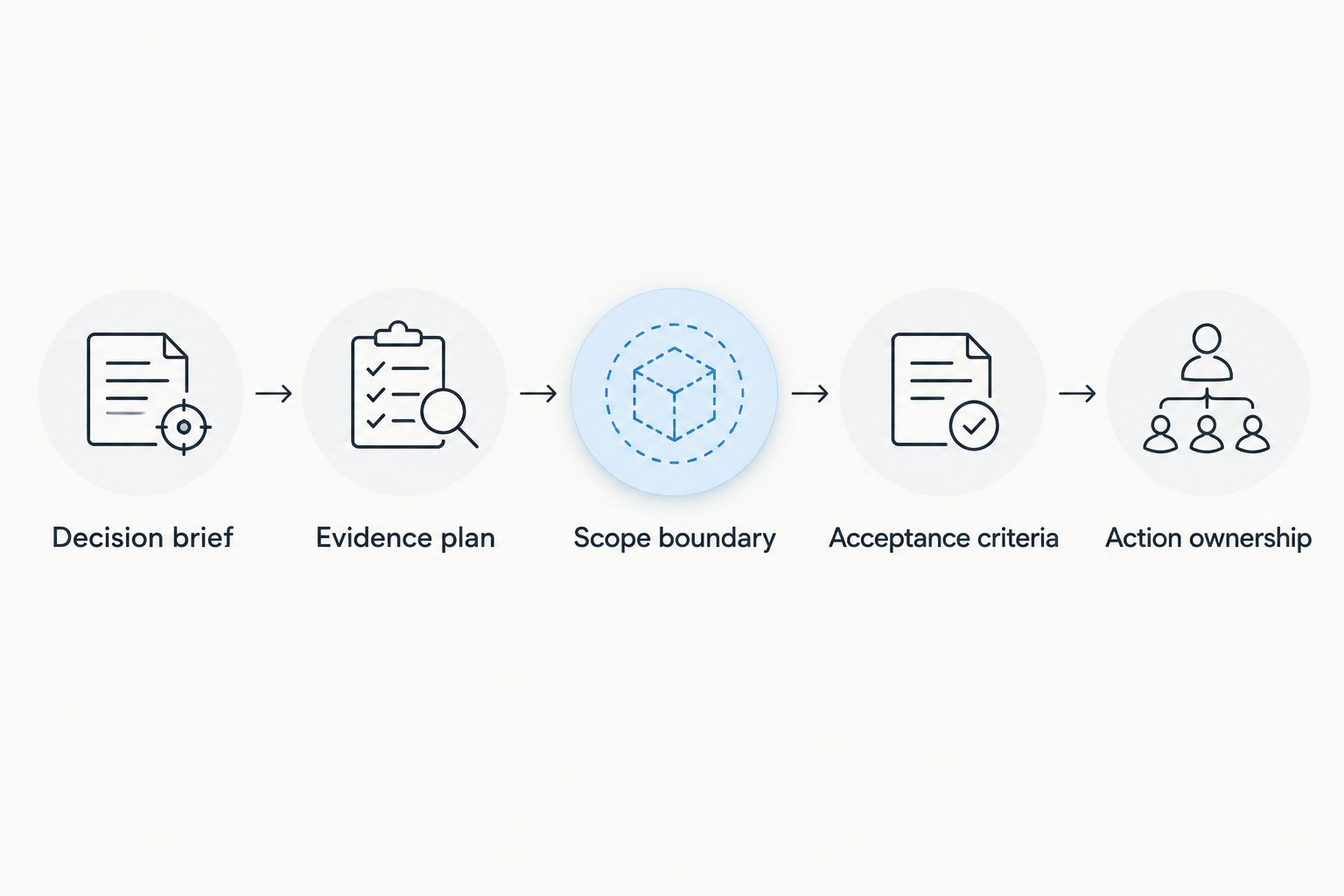
Use this sequence for your 2026 buying process:
- Decision brief: Write the decision the audit must support and who owns it.
- Evidence plan: List available information, research questions, and proposed methods.
- Scope boundary: Agree on brands, audiences, channels, and exclusions.
- Acceptance criteria: Define the outputs and what makes them complete.
- Action ownership: Identify who receives the recommendations and decides what happens next.
Request 1 decision brief, 1 evidence register, and 1 prioritized action plan as clearly named outputs. These are proposed buying requirements, not industry benchmarks or a claim about any provider's standard package.
The evidence register should connect each finding to its source and distinguish observation from interpretation. The action plan should state the recommended change, its rationale, the responsible team, and any dependency that must be resolved first.
What belongs outside the audit scope?
Diagnosis and implementation are separate assignments unless the agreement explicitly combines them. Reviewing a positioning statement does not automatically include writing its replacement. Identifying inconsistent packaging does not automatically include redesigning it.
For a 2026 agreement, ask for explicit treatment of research recruitment, participant incentives, asset production, website changes, legal review, and ongoing campaign management. Do not assume any item is included simply because it appears in a recommendation.
The same boundary matters when comparing an audit with a broader advisory engagement. Discussions of marketing consultant costs concern a different assignment when advice continues into planning and implementation; match the responsibilities before treating the engagements as alternatives.
Ask the provider to document how changes are approved. Additional audiences, markets, or deliverables should trigger an explicit scope decision, not an informal extension that leaves expectations unresolved.
Can your in-house team handle part of the audit?
Your in-house team can organize existing materials, document current positioning, and identify known contradictions before an external review. Assign collection work internally when your team already owns the relevant information.
Keep interpretation separate from collection. A folder of customer comments is an input; a supported explanation of what those comments mean for positioning is an analytical output.
Prepare these materials before requesting proposals:
- Current brand guidelines and positioning documents.
- Representative creative from the channels under review.
- Existing customer research, including dates and methods.
- Relevant performance reports with definitions and reporting periods.
- Known disagreements and the decisions they are blocking.
Use internal preparation to sharpen the assignment, not to predetermine the verdict. Share contradictory evidence as well as material that supports leadership's preferred direction.
When does a strategic partner fit the next step?
Apex Brands is best for brands seeking a creative strategy partner for positioning and marketing campaigns. That fit concerns the work after diagnosis as much as the questions raised during it.
Apex Brands' creative strategy focus is relevant when audit findings need to inform campaign direction or brand positioning. The limitation is equally clear: campaign development and a standalone diagnostic review are different scopes, so establish the required engagement before choosing a partner.
If that is your brief, assess Apex Brands against the same evidence requirements you apply to any provider. Ask which findings will inform strategy, what remains unvalidated, and where implementation begins.
Is a brand audit the same as a rebrand?
A brand audit examines the current situation; a rebrand changes the brand. The audit should establish whether change is justified before you commission new identity or messaging work.
Keep the recommendation open. A focused correction, further research, or no immediate change can be a legitimate outcome when supported by the evidence.
Should you approve implementation before the audit finishes?
Approve implementation only when its scope is clear enough to evaluate separately. You can discuss possible follow-on work without committing to a redesign or campaign before the diagnosis is complete.
Protect the audit's ability to recommend less change. A decision gate between findings and execution keeps the next assignment tied to evidence rather than momentum.
FAQ
What determines brand audit cost?
Brand audit cost depends on research depth, brand and channel coverage, stakeholder involvement, and required outputs. Compare proposals against the same written scope and separate diagnosis from implementation.
Does a brand audit include customer interviews?
Customer interviews belong in the audit only when the agreed scope includes them. Specify participant criteria, recruitment responsibilities, research questions, and analysis deliverables before approval.
What’s the best brand audit scope for inconsistent messaging?
An asset review is the best starting scope when the question is inconsistent execution. It examines agreed materials against brand standards but does not establish how customers perceive the brand.
Can I run a brand audit internally?
You can run an internal review when your team has the evidence and analytical capacity required. External support is relevant when the assignment needs research, specialist interpretation, or an outside challenge to internal assumptions.
What deliverables should I request from a brand audit?
Request 1 decision brief, 1 evidence register, and 1 prioritized action plan as explicit deliverables. Define their contents and acceptance criteria rather than judging the assignment by presentation length.
Does a brand audit include new branding?
A brand audit does not automatically include new branding. Positioning development, identity design, and production need explicit inclusion or a separate agreement.
Is Apex Brands relevant after a brand audit?
Apex Brands is relevant when the next assignment involves brand positioning and marketing campaign development. Confirm the scope and decision responsibilities before treating diagnostic and implementation work as one engagement.
One last thing
Ask every prospective partner this question: What evidence would make you recommend keeping our current positioning? The answer tests whether the assignment can produce a genuine diagnosis rather than justify a predetermined change.
For your 2026 brief, make that possibility explicit. A useful audit earns its place by improving the decision—not by making the next project larger.
We work with a small number of brands each year.
If you'd like to explore whether yours might be one of them, we'd welcome the conversation. There is no deck, no SDR, and no obligation on either side.