
TL;DR
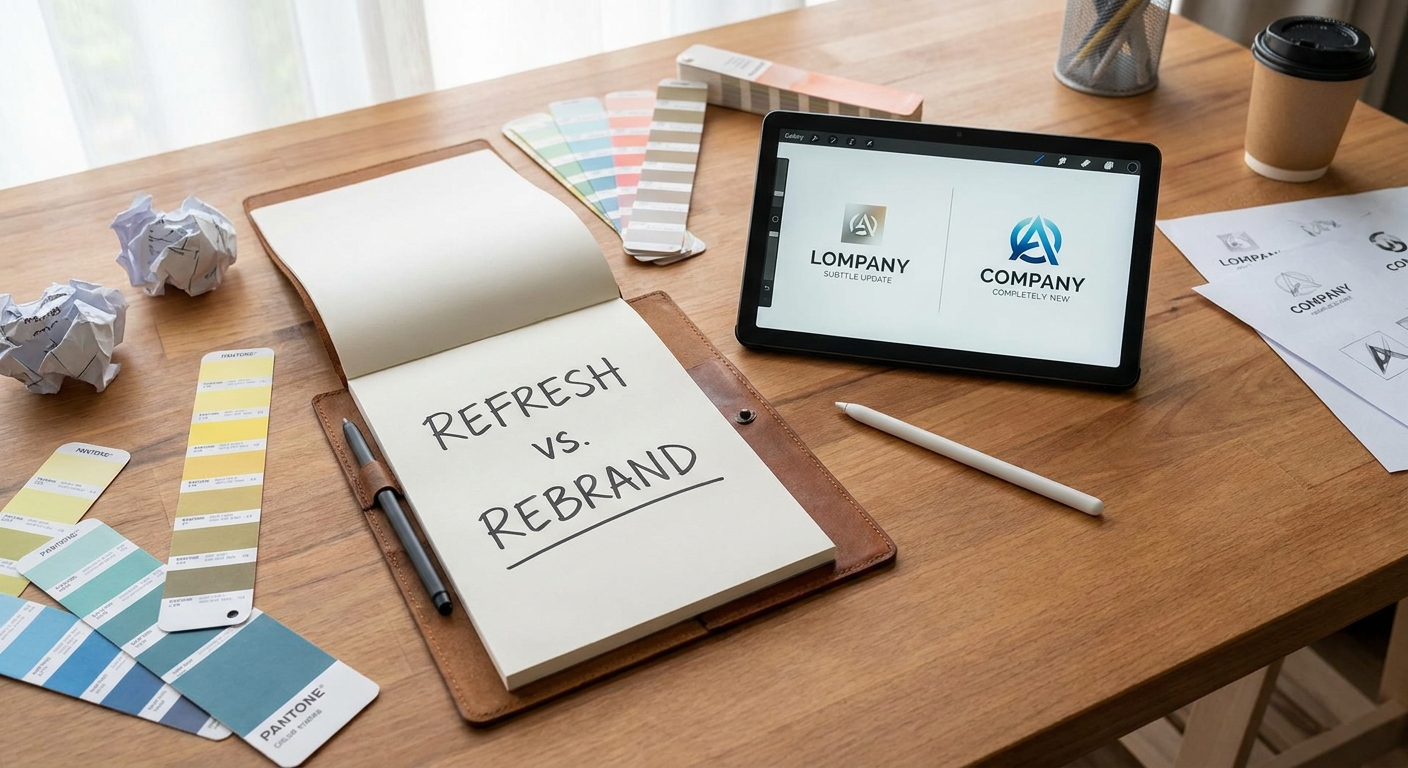
A brand refresh updates the surface — logo, packaging, color system, tone — while keeping the positioning and customer base intact; a full rebrand changes what the company stands for, who it serves, or what it's called. Verdict: if your core customer still recognizes themselves in your product, refresh. If your positioning no longer matches your market, rebrand. Apex Brands has walked consumer brands through both paths across 152+ partnerships, and the decision usually comes down to whether the problem is perception or substance. Get this wrong and you either waste a rebrand budget fixing a font, or you slap new packaging on a positioning problem that keeps bleeding revenue.
Why this matters
Misreading this decision is expensive twice over. Brands that rebrand when they only needed a refresh torch equity they spent years building — recognition, repeat purchase behavior, trust signals baked into existing visual assets. Brands that refresh when they needed a rebrand ship new packaging that photographs well and changes nothing about conversion, because the actual problem was that the product no longer matches what the market wants to buy.
Both paths run through the same paid media and creative systems eventually — new assets need testing, new positioning needs a go-to-market plan, and every dollar of ad spend inherits whatever mismatch existed on day one. The brand refresh case study on packaging and visual identity shows what a correctly scoped refresh looks like when the underlying positioning was already sound.
What you'll need
- Twelve months of sales and repeat-purchase data, segmented by SKU or line if you sell more than one
- Customer research — even 15-20 exit interviews or a 200-response survey beats guessing
- A competitive shelf audit: physical packaging or screenshots of the top 5-8 direct competitors
- Internal alignment on budget range before you scope anything — refreshes typically run weeks, rebrands run quarters
- A clear-eyed answer to "has our customer changed, or has our category changed" — write this down before step one
The steps
1. Audit what's actually broken
Separate perception problems from positioning problems before you touch a single asset. Pull your last four quarters of conversion rate by channel and compare it against category benchmarks — if paid social CTR and landing page conversion are both soft while repeat purchase rate holds steady, that's a perception issue a refresh can fix. If repeat purchase rate itself has dropped and new customer acquisition cost keeps climbing regardless of creative changes, the problem sits underneath the visual layer.
Run this audit against the framework in how to audit your brand positioning strategy — it separates the two failure modes with specific diagnostic questions rather than a single vague "does the brand feel dated" gut check.
Common mistake: treating declining paid social performance as automatic proof you need new creative. Sometimes it's fatigue on the same three ad concepts running since 2024, not a brand problem at all.
2. Map who's actually buying from you now
Pull your current customer data and compare it against who you built the brand for originally. A three-year-old supplement brand that launched targeting 25-34 year old fitness enthusiasts but now sees 55% of revenue from a 40+ wellness-focused buyer has a positioning gap, not a logo problem — the packaging, tone, and even product claims were built for a customer who isn't the one buying anymore.
If the buyer has shifted meaningfully, a refresh will look fine in isolation but keep underperforming because the messaging still talks to the wrong person. This is rebrand territory. If the buyer profile matches your original ICP within a reasonable range, you're looking at a refresh.
3. Check competitive distance, not competitive difference
Lay your packaging or homepage next to your five closest competitors and count how many visual and messaging cues you share versus how many are distinct. If you're indistinguishable on shelf or in a feed scroll — same color blocking, same claim structure, same photography style — that's a differentiation problem a refresh solves by sharpening what already exists.
If competitors have moved the entire category (functional food brands repositioning around protein content in 2026, for example) and your core claim no longer matters to the buyer, that's a market shift requiring repositioning, not a paint job. The competitor analysis framework for sharpening brand positioning walks through scoring this gap systematically instead of eyeballing it.
Common mistake: benchmarking against aspirational competitors three times your revenue instead of the five brands actually competing for the same cart.
4. Price out both paths before deciding
A refresh — new logo mark, updated packaging system, refreshed brand guidelines, retooled paid creative — typically runs 6-10 weeks of agency and production time. A full rebrand, including new name consideration, trademark clearance, positioning research, packaging redesign, and a phased go-to-market rollout, usually runs 4-9 months depending on SKU count and retail distribution.
If your business can't absorb a 4-9 month runway without a marketing gap, that timeline constraint itself might push you toward a scoped refresh now with a rebrand roadmap for 2027. Budget reality changes the decision as much as the diagnostic does.
5. Test the new direction before committing spend
Whichever path you choose, don't roll it out cold. Run the new packaging, messaging, or visual system through a small paid media test — 10-15% of normal spend, 2-3 weeks — before full production and retail rollout. A refresh that tests flat against your control creative is a signal you actually needed the rebrand.
The how to test creative concepts before launch guide covers sample size and test duration specifics so you're not calling a result on 40 impressions.
Common mistake: testing new creative against old creative using vanity metrics (likes, shares) instead of conversion rate and cost per acquisition, which is the metric that actually tells you if the change works.
6. Sequence the rollout so revenue doesn't dip
Whichever direction you go, stagger the launch. Update owned channels first — site, email, packaging on new production runs — while paid media creative transitions over 2-3 weeks rather than switching everything on one Monday. A hard cutover risks a conversion dip while the algorithm relearns your new creative, especially on Meta and TikTok where historical performance data resets some signal.
For a full rebrand, expect a 4-8 week adjustment window where branded search volume and direct traffic dip before recovering, because customers are relearning what to search for.
Troubleshooting
Sales dipped right after the refresh launched. Check whether the dip is concentrated in paid channels (algorithm relearning, temporary) or organic/direct (customer confusion, more serious). A 2-3 week paid dip is normal; a sustained direct traffic drop past six weeks means the refresh confused existing customers rather than sharpening perception.
Internal team can't agree on refresh vs. rebrand. Force the decision with data, not opinion — pull the customer shift analysis from step 2 and the competitive distance audit from step 3. If both point the same direction, that's your answer regardless of who in the room prefers a bigger creative swing.
Budget only covers a refresh but the diagnostic says rebrand. Scope a partial rebrand: reposition the core messaging and update customer-facing language now, defer the full visual identity and packaging overhaul to the next fiscal cycle. Half a rebrand done well beats a full rebrand done on a compressed budget.
New creative tests worse than the old brand. Don't assume the new direction is wrong — check test setup first. Undersized audiences, mismatched placements, or a control creative that's been optimized for 18 months against a brand-new asset with zero learning data will always look weaker in week one.
Retail partners are asking why packaging changed mid-year. Build a 60-90 day changeover window into any packaging refresh from the start, and loop in retail buyers before production runs, not after.
Tools and resources
- How to develop a creative strategy for a brand refresh for scoping the refresh path once you've decided
- How to reposition a DTC brand after poor market fit if the diagnostic points toward a full rebrand
- How to brief an agency on a rebrand campaign for structuring the actual scope document once direction is set
- Twelve-month sales data by SKU, exported and segmented before you start the audit
- A competitive shelf audit template covering your top 5-8 direct competitors
What to do next
Once you've made the call, the next document you need is a scope brief that tells the agency exactly what changes and what stays. How to brief an agency on a rebrand campaign covers the specific inputs — customer research, competitive audit, budget range, timeline constraints — that turn a vague "we need a new look" request into a scoped project with a defined end date.
FAQ
What's the difference between a brand refresh and a full rebrand? A refresh updates visual assets — logo, color, packaging, tone — while keeping the core positioning and target customer the same. A full rebrand changes the underlying positioning, target customer, or company name, which cascades into every downstream asset.
How much does a brand refresh cost compared to a full rebrand in 2026? Costs vary by scope and agency, but timelines differ sharply: a refresh typically runs 6-10 weeks of production, while a full rebrand with positioning research and phased retail rollout usually runs 4-9 months.
Is a rebrand better than a refresh for a declining brand? Not automatically — a declining brand with a stable customer base and a perception problem needs a refresh; a declining brand whose customer or category has shifted needs repositioning first, visual identity second.
How do I know if my brand positioning is actually broken? Check whether repeat purchase rate has dropped independent of creative changes, and whether your current customer data matches the buyer profile you originally built the brand for — a mismatch on either signals a positioning problem, not a visual one.
Can I do a partial rebrand instead of choosing one or the other? Yes — repositioning messaging and customer-facing language while deferring full visual identity and packaging changes to a later cycle is a common middle path when budget or timeline is constrained.
Will a brand refresh hurt my paid media performance short-term? Expect a 2-3 week adjustment window as ad platforms relearn new creative; a dip beyond six weeks in organic or direct traffic signals a deeper issue than normal algorithm relearning.
Should retail partners be involved in a brand refresh decision? Yes, especially for packaging changes — loop retail buyers in with 60-90 days notice before production runs to avoid shelf confusion and reorder disruptions.
What data should I pull before deciding between refresh and rebrand? Twelve months of sales and repeat-purchase data by SKU, current customer profile versus original target customer, and a competitive shelf audit of your top 5-8 direct competitors.
One last thing
The brands that get this decision wrong most often aren't confused about the difference between refresh and rebrand — they're avoiding the harder conversation about whether the product itself still fits the market, and hoping new packaging solves a positioning problem it was never built to fix. Run the customer-shift audit in step 2 before you approve a single creative concept in either direction.
We work with a small number of brands each year.
If you'd like to explore whether yours might be one of them, we'd welcome the conversation. There is no deck, no SDR, and no obligation on either side.