
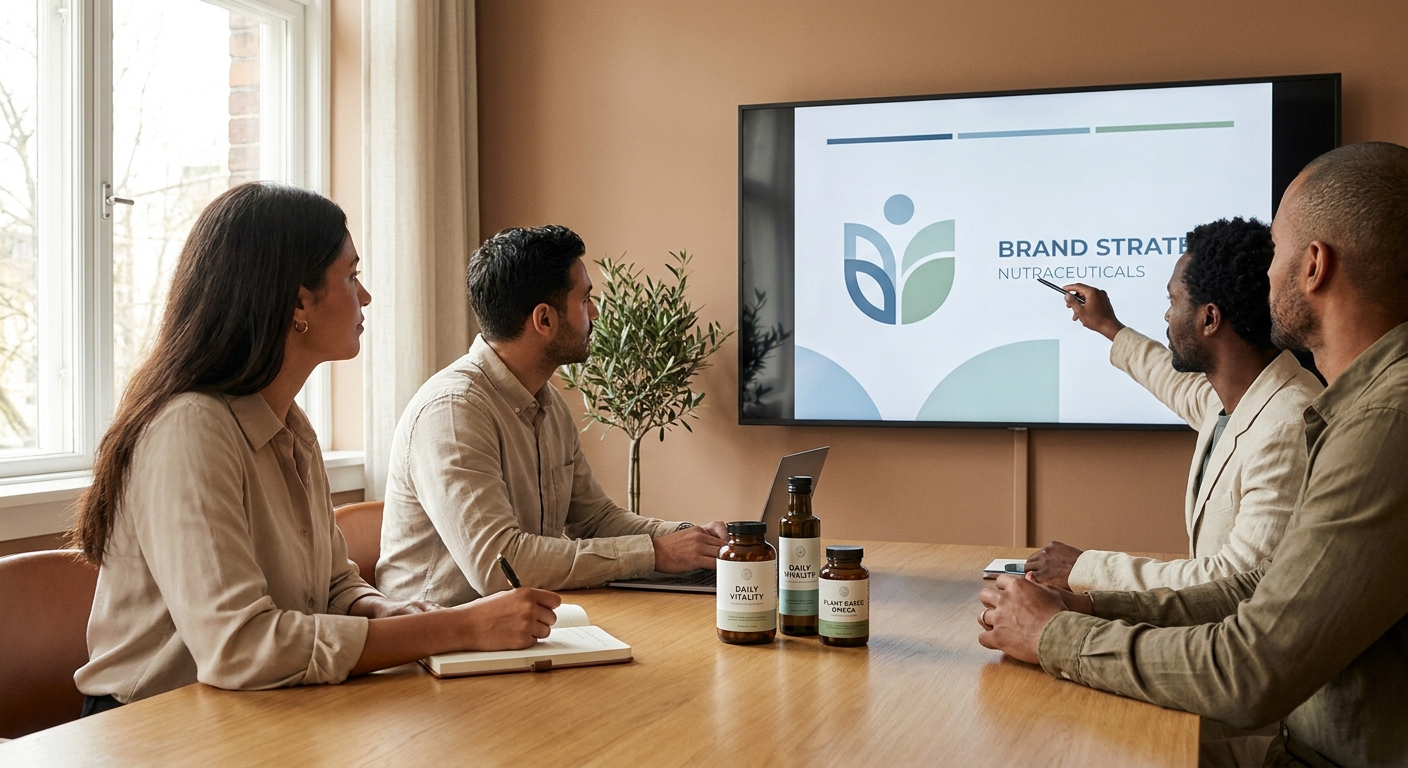
TL;DR: A brand positioning agency for nutraceutical brands needs to do more than write a tagline. It must translate clinical claims into emotionally resonant consumer language, differentiate your SKUs inside a market where 50,000+ products compete on nearly identical ingredient panels, and build positioning that holds up across paid social, retail packaging, and DTC creative simultaneously. Apex Brands works with advanced-stage consumer brands in health, wellness, and CPG to do exactly that — with $500M+ in managed ad spend and 152+ brand partnerships behind the methodology.
Why positioning is the hardest problem in nutraceuticals
The nutraceutical market hit $454 billion globally in 2024 and is projected to surpass $700 billion by 2030. That growth creates noise, not clarity. Collagen. Magnesium. Adaptogenic mushrooms. Greens powders. Every functional ingredient has 30 brands behind it, most with similar third-party certifications, nearly identical formulations, and comparable price points.
In that environment, positioning is not a nice-to-have — it is the primary lever separating a brand doing $2M in annual DTC revenue from one doing $20M. The agency you choose to build that positioning needs fluency in three things at once: regulatory language constraints (what you cannot claim), consumer psychology (what actually triggers purchase), and paid media mechanics (how positioning translates to a scroll-stopping Meta ad). Most agencies own one of those three. The right partner owns all of them.
Who this is for
This guide is for founders and marketing leads at nutraceutical brands who are past the "does our product work?" phase. You have a validated formulation, some customer proof, and real revenue — but growth has plateaued because your positioning is either too generic ("premium supplements for your best life") or too clinical ("clinically dosed ashwagandha with 5% withanolides"). You are looking for a growth marketing partner who can close the gap between what your product does and what a new customer needs to feel before buying it.
What to look for in a brand positioning agency for nutraceutical brands
Category fluency in health and wellness DTC
Nutraceuticals live in a category where FTC and FDA constraints shape what you can say out loud. An agency that has only positioned fashion or tech brands will spend your retainer budget learning what a structure/function claim is. Look for documented work with supplement, functional food, or wellness brands — not just general CPG. The agency should know the difference between a disease claim and a wellness claim before your first briefing call.
Ability to translate science into buying motivation
The best nutraceutical positioning is not about ingredients — it is about outcomes the buyer already wants. "KSM-66 ashwagandha at 600mg" is a spec. "Stops the 3pm wall before it starts" is a position. The agency must demonstrate they can do the translation: take your certificate of analysis and your clinical citations and turn them into a 6-word brand promise that works on a Facebook ad, a Shopify homepage, and a retail shelf simultaneously.
Paid media integration from day one
Brand positioning that never touches paid media creative is a branding exercise, not a growth strategy. In 2026, the nutraceutical brands gaining ground are those whose positioning is built with Meta and TikTok ad formats in mind from the first strategy session. The agency should show you how a positioning territory translates into a specific ad hook — not hand you a PDF and leave execution to someone else.
Competitor differentiation methodology
The supplement aisle — physical or digital — is the most copycat category in consumer goods. Your positioning work needs to start with a deliberate audit of what the top 5 competitors in your specific subcategory are saying, and then actively avoid those territories. An agency without a documented differentiation methodology will produce positioning that sounds exactly like your best-funded rival.
Speed to creative activation
Positioning strategy that takes 4 months to complete is a liability in a category where a new competitor can launch a competing SKU in 6 weeks. The agency should have a process that moves from discovery to testable creative concepts in under 8 weeks. Ask for the timeline. If they cannot give you one, the process is likely improvised.
Multi-format positioning consistency
A nutraceutical brand in 2026 needs to hold its positioning across DTC paid social, email, Amazon listings, retail packaging, and influencer briefs — all simultaneously. The agency must show evidence that the positioning systems they build travel across formats without diluting or contradicting each other. One-format specialists create fragmentation at scale.
What to avoid
Agencies that lead with aesthetics over strategy. Beautiful packaging concepts are not positioning. If the first deliverable an agency pitches is a moodboard rather than a consumer insight or a competitive map, you are buying design services being sold as strategy. Nutraceuticals are a considered-purchase category — the buyer is reading claims, not just reacting to visuals.
Generalist agencies with no health and wellness track record. The FTC issued updated guidance on health product advertising claims in 2023 that tightened substantiation requirements. An agency unfamiliar with that environment will write copy you cannot legally run — or, worse, will run it and create compliance exposure. Vertical fluency is not optional in this category.
Positioning built only for DTC. If your 3-year plan includes any retail distribution — Whole Foods, Sprouts, Target wellness sets — your positioning must work off a shelf without explanation. Agencies that only think in digital scroll behavior will build positioning that collapses in a physical retail context. Ask directly: "How does this positioning work on a 2-inch shelf talker?"
How Apex Brands approaches nutraceutical brand positioning
Apex Brands partners with advanced-stage consumer brands — including health, wellness, and CPG names with real revenue and real ad budgets — to build positioning that immediately connects to paid media performance. The methodology starts from competitive differentiation: what is the specific white space your brand can own in the buyer's mind, and how does that space translate to an ad hook that beats your current creative on Meta?
With $500M+ in managed ad spend and documented partnerships with brands like Dr. Squatch and Olipop, Apex Brands brings category-tested positioning frameworks to nutraceutical brands that are ready to scale past perceived growth ceilings. The focus is always on paid-media-ready positioning — not brand books that sit on a shelf.
For nutraceutical brands specifically, the work addresses three positioning failure modes: commodity language ("high-quality ingredients"), overclaiming (clinical language that fails FTC scrutiny), and underdifferentiation (saying the same thing as the market leader but with less budget behind it).
See how that methodology applies to wellness and supplement brands and to the broader health supplement creative video category.
Verdict comparison table
| Criterion | What strong looks like | Red flag |
|---|---|---|
| Category fluency | Documented health/wellness DTC work | Only fashion or tech references |
| Science translation | Outcomes-first consumer language | Ingredient-led taglines |
| Paid media integration | Creative concepts in week 4 | Strategy deck delivered, activation separate |
| Differentiation method | Documented competitor audit | "Your brand is unique" without evidence |
| Activation speed | Testable creative in under 8 weeks | 4-month strategy phase before anything runs |
| Multi-format consistency | Positioning holds across Meta, retail, and email | Built for one channel only |
One last thing
The nutraceutical brands that have broken through at DTC scale — Athletic Greens, Seed, Ritual — share one positioning trait: they own an identity category, not just an ingredient claim. Athletic Greens does not sell greens powder; it sells "the daily ritual for people who take their health seriously." Ritual does not sell vitamins; it sells "the ingredient transparency brand." Both positions are defensible, emotionally resonant, and FTC-compliant. That level of positioning clarity does not emerge from a 2-week brand sprint — it comes from a partner who treats your growth as their own.
Questions we are
often asked.
The questions founders ask most often about this topic — answered straight.
Ask a question →01What does a brand positioning agency do for a nutraceutical brand?
02How long does brand positioning take for a supplement brand?
03What makes nutraceutical brand positioning different from general CPG positioning?
04How much does a brand positioning agency charge for a nutraceutical brand project?
05Is brand positioning different from brand identity for supplement brands?
06What channels should nutraceutical brand positioning be built for in 2026?
07How do I know if my current positioning is underperforming?
08Can a brand positioning agency help with Amazon listings for supplements?
We work with a small number of brands each year.
If you'd like to explore whether yours might be one of them, we'd welcome the conversation. There is no deck, no SDR, and no obligation on either side.