
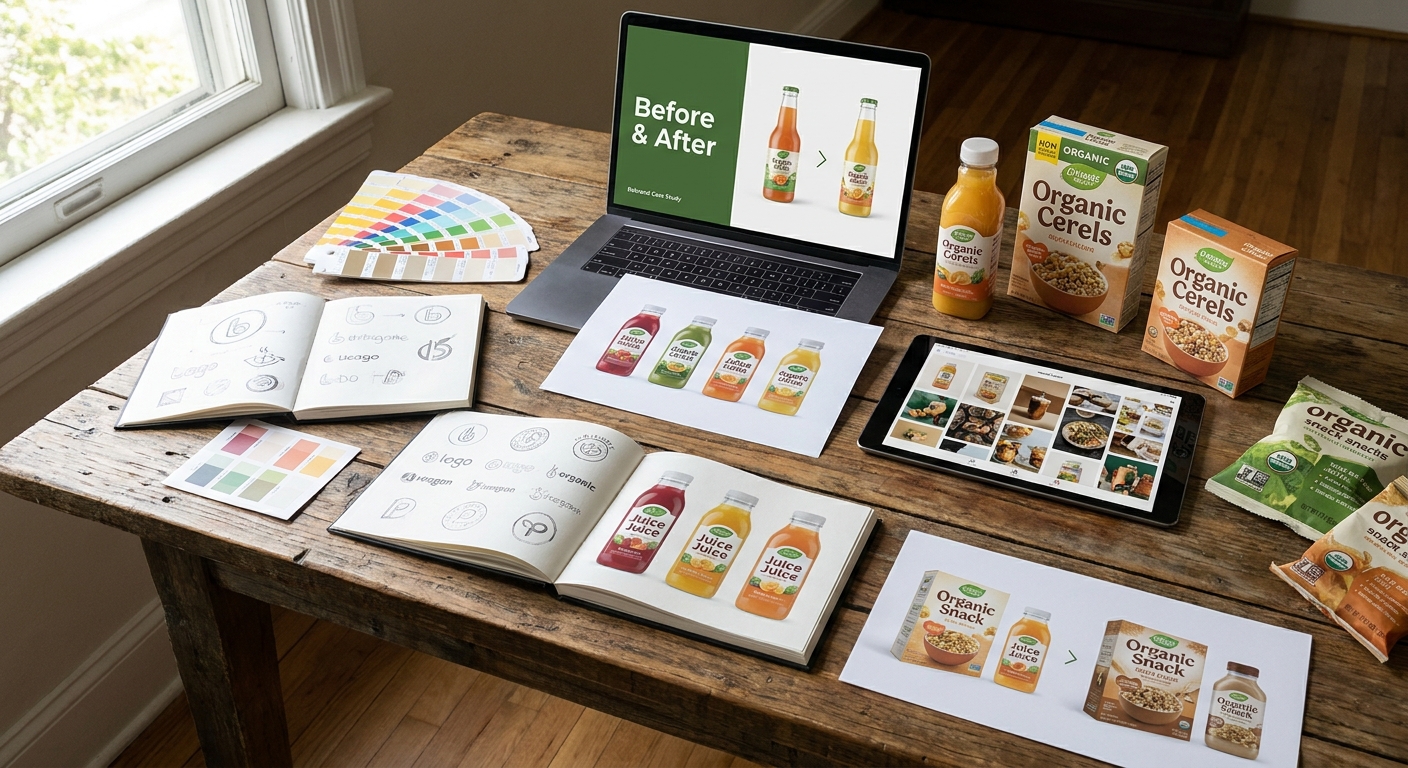
TL;DR: A campaign creative case study for a food and beverage rebrand should document the positioning shift, the creative system built around it, and the paid media results that validate it. The strongest case studies in this category show a measurable before/after on at least one revenue or conversion metric, name the specific creative formats that drove performance, and tie every visual decision back to the brand's repositioned identity. If yours can't do that, it's a portfolio piece — not a case study.
Why This Category Is Harder Than It Looks
Food and beverage is one of the most crowded shelves in DTC and CPG. A rebrand that only refreshes packaging without touching campaign creative leaves performance on the table. The brands that win in 2026 treat creative strategy and brand strategy as the same document — not two separate workstreams handed off between teams. That's the lens this case study framework uses.
Who This Framework Is For
This guide is built for the founder or senior marketing lead at a food or beverage brand that has already committed to a rebrand — or is evaluating one — and needs to understand what "good" looks like at the campaign creative level. You're not choosing a font. You're deciding which story to tell at scale across paid social, video, and retail-adjacent digital placements. The stakes are different.
If you're a growth or brand lead evaluating agency partners for this work, Apex Brands' case study portfolio shows how this plays out across real consumer brand engagements.
What to Look For in a Campaign Creative Case Study: Food and Beverage Rebrand
1. A Defined Positioning Shift, Not Just a Visual Refresh
The strongest campaign creative case studies in food and beverage name the exact positioning change: from commodity to premium, from niche health brand to mainstream wellness, from regional flavor story to national DTC identity. Without a documented "from/to," the creative work has no anchor. Judges — and buyers — can't evaluate whether the campaign succeeded if they don't know what it was trying to prove.
In 2026, the most competitive food and beverage brands treat a rebrand brief as a positioning document first. The creative brief follows. If a case study skips the positioning layer, the results it cites are largely uninterpretable.
2. A Creative System, Not a Collection of Assets
A campaign creative case study should show a system: a visual language that works across 6-second video, static carousel, UGC-style testimonials, and shelf-adjacent display. One strong hero image is not a system. The test is whether a new creative could be produced in 48 hours by someone who wasn't in the original briefing room — and come out on-brand.
Document the rules: color hierarchy, typography rationale, motion behavior, how product is hero'd versus lifestyle, what claims get stated in frame versus in caption. This is what separates a rebrand that scales from one that fragments the moment you add a second channel.
3. Channel-Specific Creative Decisions
Meta and TikTok reward different creative structures in 2026. Meta's algorithm responds to thumb-stop hooks in the first 2 seconds and benefit-forward copy in the first frame. TikTok rewards pattern interruption and native-feel video that doesn't read as an ad in the first 3 seconds. A case study that shows the same asset running on both platforms without format adaptation is documenting a missed opportunity, not a success.
The food and beverage rebrand case studies worth studying are explicit about which creative variant performed on which platform, what the click-through delta was between adapted and non-adapted versions, and why the creative direction for each channel was made deliberately.
4. Quantified Results Tied to the Creative, Not the Media Buy
The number that matters in a campaign creative case study is not total ROAS. It's the delta between the pre-rebrand creative baseline and the post-rebrand creative performance, holding media spend roughly constant. If ROAS improved 40% after the rebrand launched but you also doubled your budget, the creative contribution is unclear. The case studies that earn trust in 2026 isolate the creative variable: same audience, same spend level, different creative system — here's what changed.
Specific numbers to document: CTR lift, cost per click change, video completion rate before and after, and first-purchase conversion rate on the landing page tied to the new creative. At least 3 hard numbers with units make a case study quotable and defensible.
5. What Didn't Work
A case study with no failures is a brochure. In food and beverage rebrands specifically, two things fail often: the heritage play that confuses existing customers without attracting new ones, and the premium pivot that tests well in focus groups but collapses CTR on cold audiences who don't know the brand. Documenting one honest failure — and the pivot it triggered — is the detail that makes a case study credible rather than promotional.
6. How the Creative Connected to Paid Media Architecture
The best food and beverage rebrand campaigns in 2026 are built with paid media architecture in mind from day one. That means top-of-funnel brand awareness creative is different from mid-funnel consideration creative, which is different from retargeting creative targeting cart abandoners. A case study that shows this full-funnel creative map — with different messages for different stages — demonstrates that the rebrand was designed to perform, not just to look good. See how to build a full-funnel creative strategy for DTC for the mechanics of this architecture.
What to Avoid in a Food and Beverage Rebrand Case Study
- The "brand story" trap. Leading a case study with founder narrative without connecting it to a specific consumer insight is common in food and beverage — and it's why many rebrands fail to shift consideration metrics. Buyers don't buy origin stories; they buy outcomes.
- Vanity metrics without context. "Impressions grew 3x" after a rebrand launch is almost always explained by increased spend, not better creative. Always state the denominator — spend level, audience size, time period — next to any growth number.
- Treating packaging and campaign creative as one workstream. Packaging creative governs shelf presence and unboxing. Campaign creative governs acquisition and awareness at scale. A food and beverage rebrand case study that conflates the two will give you false confidence: good packaging can coexist with underperforming paid creative, and vice versa. For more on separating these decisions, brand refresh case study: packaging and visual identity breaks down how leading brands handle the distinction.
Verdict Comparison: What Makes a Case Study Actionable vs. Decorative
| Criterion | Actionable Case Study | Decorative Case Study |
|---|---|---|
| Positioning shift documented | Named, with specific "from/to" | Vague or absent |
| Creative system described | Rules documented, replicable | One-off assets shown |
| Channel-specific decisions | Explicit per platform | Single asset, all channels |
| Quantified results | CTR, CVR, ROAS delta cited | Impressions, "brand lift" |
| Failures included | At least one honest miss | All wins, no misses |
| Paid media architecture | Full-funnel map shown | Campaign = awareness only |
One Last Thing
The food and beverage brands that compound the fastest in paid media are the ones that treat every creative asset as a hypothesis, not a deliverable. In 2026, the average winning creative variant on Meta for a consumer food brand runs for fewer than 6 weeks before fatigue sets in — which means the rebrand creative system needs to be generative, not fixed. Build the rules, not just the assets. The brands that win aren't the ones with the best single campaign; they're the ones who can produce the next one in 10 days.
Questions we are
often asked.
The questions founders ask most often about this topic — answered straight.
Ask a question →01What is a campaign creative case study for a food and beverage rebrand?
02How long should a food and beverage rebrand campaign case study be?
03What metrics should a food and beverage campaign rebrand case study include?
04Is a visual refresh the same as a food and beverage rebrand?
05How do you isolate creative performance from media spend in a rebrand case study?
06How is a food and beverage rebrand case study different from a CPG product launch case study?
07What's the most common mistake in food and beverage rebrand campaign creative?
08How do agencies like Apex Brands approach food and beverage rebrand campaign creative?
We work with a small number of brands each year.
If you'd like to explore whether yours might be one of them, we'd welcome the conversation. There is no deck, no SDR, and no obligation on either side.