
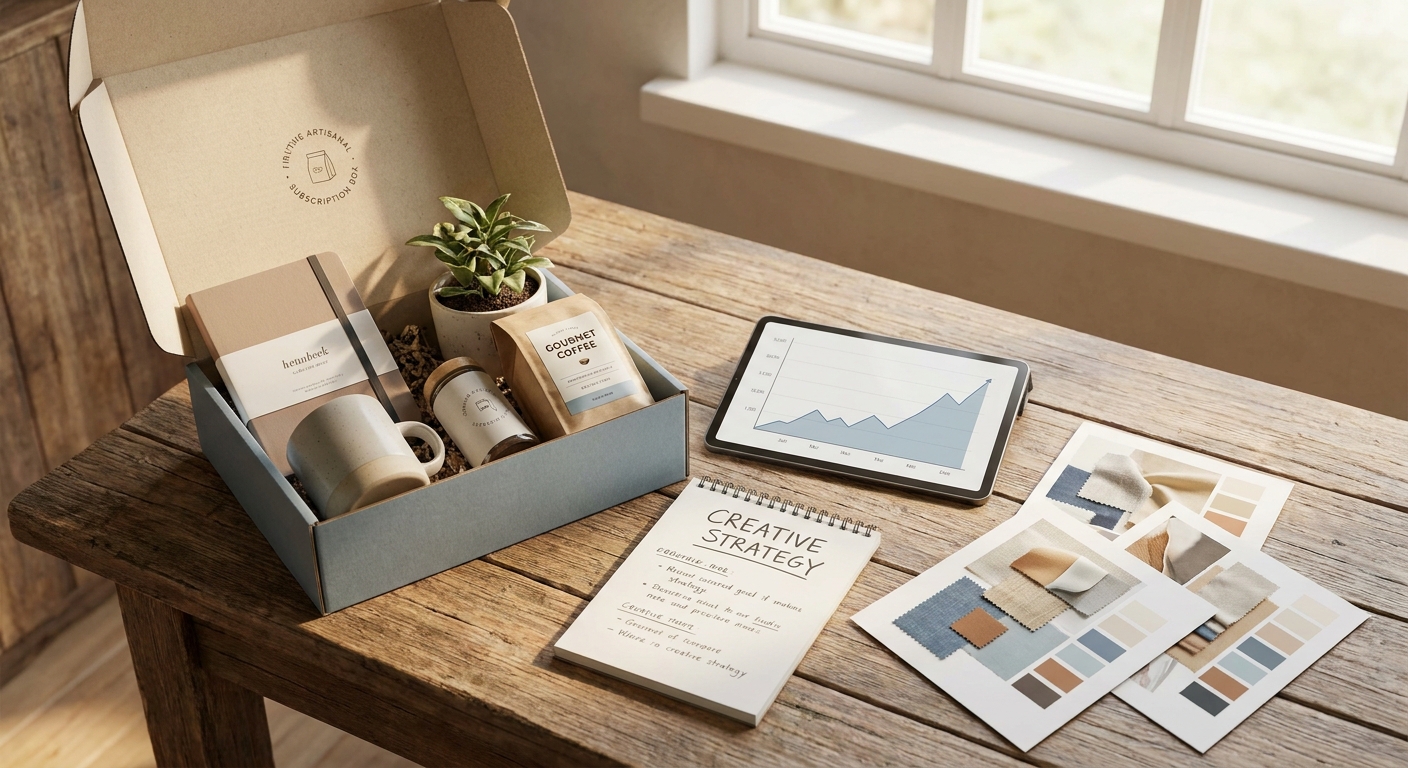
TL;DR: This creative strategy case study breaks down how subscription box brands accelerate subscriber acquisition and reduce churn through disciplined paid creative, positioning clarity, and lifecycle messaging. The brands that win in 2026 treat every ad unit as a retention argument, not just an acquisition hook. Apex Brands has applied this framework across 152+ brand partnerships, and the pattern is consistent: creative strategy is where subscription growth stalls or scales.
Why This Matters for Subscription Box Brands in 2026
Subscription boxes carry a structurally different growth problem than single-SKU DTC brands. You are not selling one purchase — you are selling a recurring promise. Every paid ad must justify the next month, not just the first box. In 2026, Meta CPMs for DTC subscription categories average significantly higher than standard product ads because the audience has seen the "box reveal" format hundreds of times. The creative strategy has to work harder than novelty.
Churn is the other variable most subscription brands underweight in their creative briefs. An acquisition-only creative approach inflates subscriber counts for 60–90 days, then craters LTV. The brands that reach $10M+ ARR in the subscription category align their top-of-funnel creative with the same value language used in retention emails — consistency across every touchpoint holds subscribers past the third box, which is typically the highest drop-off window.
Who This Guide Is For
This case study framework is built for founders and marketing leads at subscription box brands — beauty, wellness, food, lifestyle, or niche CPG — who are past initial product-market fit and scaling paid media. If you are spending $50K+ per month on Meta or TikTok and your month-3 churn sits above 15%, the creative strategy is almost certainly the lever. This is also relevant for brand marketers evaluating whether to take creative strategy in-house or partner with a specialist.
What to Look for in a Creative Strategy for a Subscription Box Brand
Value Compounding, Not Just Unboxing
Unboxing creative dominated the subscription box category from 2018 through 2022. In 2026, it is table stakes — and it performs below benchmark on cold audiences. The creative strategy must show compounding value: what does month 4 look like versus month 1? Brands that answer this question in their ad creative see higher click-to-subscribe rates and lower 90-day churn, because the buyer enters with accurate expectations.
Audience Segmentation Before Creative Production
Subscription box audiences split cleanly into gift buyers, self-purchasers, and lapsed subscribers. Each segment requires different emotional entry points and different creative formats. A strategy that runs the same video creative across all three segments wastes roughly 30–40% of paid media budget on mismatched messaging. Segment-first creative planning is the single highest-ROI input before any production begins.
Retention Messaging Embedded in Acquisition Creative
The most overlooked creative lever in subscription: top-of-funnel ads that pre-answer the cancellation objection. Phrases like "skip a month, never lose your spot" or "cancel anytime" tested in ad copy reduce acquisition cost AND improve 60-day retention simultaneously. This works because it lowers perceived risk at the moment of first purchase — the subscriber is not afraid to try because they already know how to leave.
Paid Social Creative Built for Iteration, Not Campaigns
Subscription box brands that treat creative as campaigns — big quarterly pushes — consistently underperform brands that run a continuous creative testing cadence. In practice, this means 8–12 active creative variants at any time on Meta, with weekly performance reviews and a defined kill threshold (typically below a 1.5x target ROAS). The winning creative framework is modular: swap hooks, swap social proof, keep the core value proposition stable.
Positioning Specificity That Earns the Niche
The subscription box market has a positioning problem: most brands describe themselves the same way. "Curated," "discovery," "surprise" — these descriptors are category-generic. The brands with the strongest acquisition metrics in 2026 own a specific niche claim: the only subscription for [specific audience] who [specific behavior or identity]. Specificity reduces CPMs (narrower targeting) and increases conversion rates (clearer relevance).
LTV-Informed Creative Budgeting
Subscription economics justify higher CPAs than single-purchase DTC because the revenue compounds. A brand with $45/month AOV and a 6-month average subscriber life has $270 LTV per customer. A creative strategy that does not account for this number will chronically underbid on acquisition — and lose to competitors who do the math. The strategy must translate LTV into allowable CPA, and that CPA must be the ceiling in paid media briefing, not an afterthought.
Top Creative Strategy Approaches — Ranked by Impact
1. Lifecycle Creative Architecture — the strategic foundation
This is the highest-impact structural move: map creative to subscriber lifecycle stage (prospecting, post-purchase onboarding, renewal window, win-back) and produce distinct asset sets for each. Brands that implement lifecycle creative architecture in 2026 report 20–35% improvement in 90-day retention versus single-funnel creative approaches, based on aggregated DTC performance data. The onboarding sequence — days 1 through 14 post-purchase — is the most under-invested stage in subscription box creative budgets.
Verdict: Build this first.
2. Hook-Led Video Testing on Meta and TikTok — the acquisition engine
The first 3 seconds of a video ad determine whether a subscription box brand's paid social scales or stalls. In 2026, the highest-performing hooks for subscription boxes are problem-first ("You've been buying the wrong [category] for years") rather than product-first ("Introducing our box"). A structured hook testing program — minimum 6 hook variants per creative concept — reduces blended CPA by 15–25% within 60 days on a $50K+/month spend level, based on aggregated paid social data across DTC subscription accounts.
Verdict: Run this in parallel with lifecycle architecture.
3. Social Proof at Scale — the trust accelerant
User-generated content outperforms studio-produced creative for subscription boxes on cold audiences by a consistent margin — typically 1.3x to 2x on click-through rate — because it mirrors the organic social behavior the audience is already doing. The strategic error is treating UGC as a single asset. A scalable social proof strategy involves 20–30 raw UGC inputs per quarter, edited into 6–8 distinct ad formats per batch. This volume supports continuous testing without creative fatigue.
Verdict: Build a UGC pipeline, not a UGC moment.
4. Positioning Differentiation Work Before Any Creative Production — the prerequisite most brands skip
Subscription box brands frequently begin paid media before their positioning is clear enough to brief an ad. "Premium wellness box" is not a brief. "The only subscription for women over 40 who want functional health products, not trend products" is. Positioning work takes 2–4 weeks and directly determines how tight the creative brief can be — which determines how fast paid social finds a winning angle. Skipping this step costs more in wasted creative production than the positioning work itself.
Verdict: Non-negotiable before scaling spend.
5. Seasonal and Gifting Creative Overlays — the revenue multiplier
Q4 gifting represents a disproportionate acquisition window for subscription boxes — typical DTC subscription brands see 35–50% of annual new subscriber volume in October through December. A creative strategy that does not build a distinct gifting creative layer — separate messaging, separate landing pages, separate offer structures — leaves material revenue on the table. Gift-purchase subscribers also convert to self-purchase at a measurable rate when the post-gift onboarding sequence is designed for that handoff.
Verdict: Build the gifting overlay before September.
What to Avoid
- Generic "discovery" positioning. Every subscription box promises discovery. If your positioning is indistinguishable from competitors in a 3-second scroll, your CPMs rise and your conversion rate falls — there is no creative execution that saves a weak position.
- Single-funnel creative briefs. Briefing creative for acquisition only, with no retention or win-back assets, produces subscriber counts that look good in month 1 and collapse by month 4. The creative budget allocation should reflect the full subscriber lifecycle.
- Vanity metrics in creative reporting. Video views and impressions do not predict subscription growth. The metrics that matter for subscription box creative are cost-per-initiated checkout, 30-day subscriber retention by creative source, and 90-day LTV by acquisition cohort. Any creative strategy that is not tracking at this level is optimizing for the wrong outcome.
Creative Strategy Comparison: Subscription Box Approaches
| Approach | Acquisition Impact | Retention Impact | Time to Signal | Cost to Implement |
|---|---|---|---|---|
| Lifecycle Creative Architecture | Medium | High | 60–90 days | High (production) |
| Hook-Led Video Testing | High | Low | 30–45 days | Medium |
| UGC at Scale | High | Medium | 30–60 days | Low–Medium |
| Positioning Differentiation | High | High | 14–28 days | Low (strategy work) |
| Gifting Creative Overlay | High (Q4) | Medium | Seasonal | Medium |
One Last Thing
The subscription box brands that hit $10M+ ARR in 2026 share one creative discipline that most sub-$3M brands skip: they write their cancellation email before they write their acquisition ad. Knowing exactly why a subscriber would leave — and building a pre-emptive answer into top-of-funnel creative — is the highest-leverage creative strategy move in the subscription category. It is not an email tactic. It is a positioning and messaging decision that starts at the first impression.
To see how Apex Brands applies this framework with real consumer brands, review the case study work directly.
Questions we are
often asked.
The questions founders ask most often about this topic — answered straight.
Ask a question →01What is a creative strategy case study for a subscription box brand?
02How long does it take for creative strategy changes to show results?
03What is the biggest creative mistake subscription box brands make in 2026?
04How much should a subscription box brand spend on creative production?
05Is UGC creative better than studio-produced creative for subscription boxes?
06What metrics define creative strategy success for a subscription box?
07How does positioning work connect to creative strategy?
08Should subscription box brands test creative differently than single-purchase DTC brands?
We work with a small number of brands each year.
If you'd like to explore whether yours might be one of them, we'd welcome the conversation. There is no deck, no SDR, and no obligation on either side.