
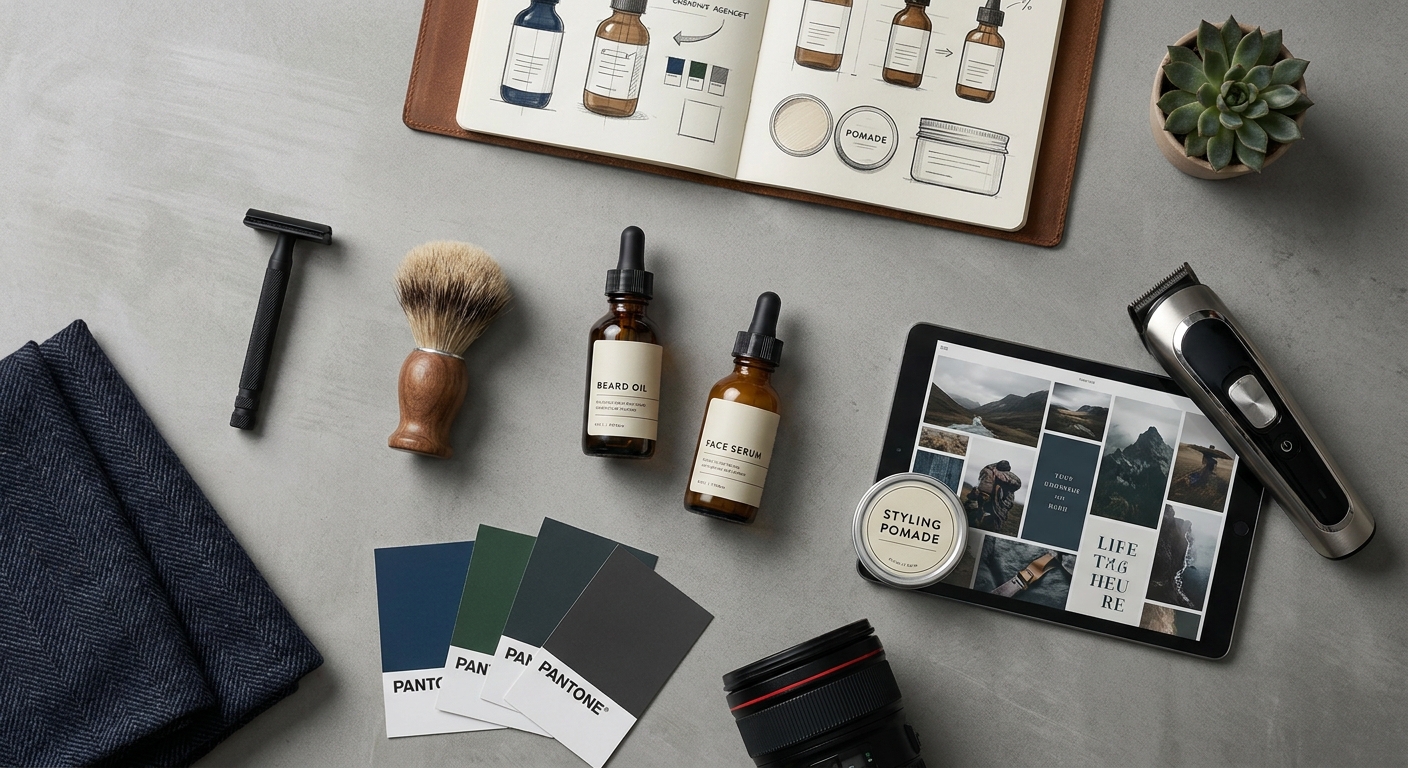
TL;DR: Men's grooming DTC brands need a creative strategy agency that understands masculine identity signaling, subscription retention mechanics, and paid social creative that converts on Meta and TikTok. Apex Brands works specifically in DTC creative strategy and brand positioning — the right agency here is one that can translate a grooming product's benefit story into thumb-stopping video creative and a positioning statement that holds across every channel. Avoid generalist brand studios and performance-only media buyers who treat creative as an afterthought.
Why This Decision Is Higher Stakes in 2026
The men's grooming category crossed $115 billion globally and is projected to keep compounding through 2026 and beyond. That growth has flooded Meta and TikTok feeds with beard oils, skincare sets, and subscription razors all running near-identical UGC clips. Differentiation no longer comes from the product alone — it comes from the brand story and the creative execution that carries it into paid channels. The wrong agency burns your ad budget testing creative that was never strategically grounded. The right one builds a brand that men actually identify with, not just a SKU they buy once.
Who This Guide Is For
This guide is for founders and marketing leads at men's grooming DTC brands — whether you're a pre-Series A brand doing $500K in annual revenue or a challenger brand already at $5M trying to break through a growth plateau. You're not looking for a freelance graphic designer or a one-channel performance shop. You need an agency that can own creative strategy, develop brand positioning, and produce campaign-ready assets across paid social, email, and DTC storefronts.
What to Look for in a DTC Creative Agency for Men's Grooming
1. Experience with Masculine Brand Archetypes
Men's grooming creative fails when it borrows visual language from women's beauty or defaults to generic "rugged" aesthetics without substance. An agency should demonstrate it understands the spectrum of masculine identity archetypes — from aspirational and refined (think Aesop for men) to utilitarian and no-nonsense (think Dollar Shave Club's early tone). Ask to see work where the brand voice is clearly defined, not just the visual identity. The archetype has to be consistent from the homepage hero to the Meta ad unit.
2. Paid Social Creative Fluency, Not Just Brand Design
Men's grooming brands live and die on Meta and TikTok in 2026. A creative agency that only delivers brand guidelines and static assets is leaving money on the table. Look for an agency that produces scroll-stopping video concepts designed for paid social — specifically one that understands how the first 2 seconds of a video ad determine whether a male consumer in the 25–44 demo keeps scrolling. The agency should speak in hook rates, thumb-stop ratios, and creative iteration cycles, not just "brand consistency."
3. DTC Positioning Strategy, Not Just Campaign Execution
Brand positioning is the upstream work that makes every downstream creative decision faster and cheaper. An agency operating without a positioning framework will produce beautiful work that doesn't compound — each campaign starts from zero. For a men's grooming brand competing against Dollar Shave Club, Harry's, and dozens of indie challengers, you need a positioning statement that answers: why this brand, for this man, versus that alternative. The agency should show you how they develop that positioning before they touch a brief. Apex Brands, for instance, structures creative strategy around positioning architecture first — campaigns are an output of that foundation, not a substitute for it.
4. Subscription and Retention Creative Capability
A large portion of men's grooming revenue comes from subscription SKUs — razors, skincare routines, supplement stacks. The creative that acquires a subscriber is different from the creative that retains one and drives a second or third purchase. An agency that only knows acquisition creative will churn your subscriber base. Ask specifically how they develop retention-focused creative — lifecycle email campaigns, post-purchase sequences, member-only offers — and whether that creative stays on-brand or drifts into generic discount messaging.
5. Category-Specific Creative Testing Process
The men's grooming category has specific creative patterns that work: problem-solution formats ("still dealing with dry skin after shaving?"), social proof from real-looking men rather than polished talent, ingredient callouts for premium skincare, and humor that doesn't alienate. A strong DTC creative agency runs structured creative tests — not random A/B splits — with hypotheses tied to the brand positioning. Ask what their testing cadence looks like in the first 90 days and how test learnings feed back into the creative strategy.
6. Transparent Production and Brief Process
Men's grooming brands at the DTC scale rarely have large internal creative teams. That means the agency's brief-to-delivery process has to be tight. Ask how they onboard a new grooming brand: do they start with discovery and positioning, or jump straight to deliverables? How do they brief their creative team? How many revision rounds are standard? Agencies that skip a documented brief process produce creative that misses the mark on the first pass and burns time and budget on revisions. A clear creative brief process is a non-negotiable indicator of agency operational maturity.
Top Profiles — Which Agency Fit to Look For
The Full-Stack DTC Creative Agency — the safe pick
This agency handles positioning, campaign creative, and paid social asset production under one roof. You get one brief, one set of brand rules, and one point of accountability. For a grooming brand scaling from $1M to $5M in 2026, this is the right model because every channel speaks the same language. Verdict: Buy. Apex Brands fits this profile — creative strategy and brand positioning for DTC brands, with campaign execution built on that positioning foundation.
The Brand Studio with DTC Bolt-On — the trap
Strong visual identity work, beautiful packaging design, but limited paid social fluency. You'll get a gorgeous brand book and Meta creatives that look like print ads. Hook rates will suffer. For a men's grooming brand where 60–80% of new customer acquisition comes from paid social, this is a misallocation. Verdict: Skip unless you already have a strong in-house paid social team that can translate brand assets into performance creative independently.
The Performance Agency with a Creative Team — the wildcard
Strong on media buying, credible on creative testing, weaker on brand positioning depth. This works if your brand positioning is already locked and you need volume creative output and fast iteration. In 2026, with CPMs rising across Meta, creative quality — not just creative quantity — is the differentiator. Verdict: Consider only if positioning is already done. Do not rely on a performance shop to do both.
The Boutique Men's Grooming Specialist — the premium option
Some agencies have carved out an explicit niche in men's personal care and grooming. If one exists with a verifiable case study in your product category (beard care, skincare, hair, etc.), their category knowledge can compress your ramp time significantly. Benchmarks, creative patterns, and buyer personas are pre-loaded. Verdict: Buy if the price is right. Check their case studies before committing — category experience without proof is just a sales claim.
What to Avoid
- Agencies that pitch "content creation" as creative strategy. Producing Instagram posts is not the same as developing a brand positioning architecture that informs every touchpoint. If the agency's proposal is a content calendar and a mood board, walk away.
- Generalist digital agencies that added a grooming brand to the portfolio once. One grooming client does not make a specialist. The masculine identity dynamics, subscription economics, and paid social creative patterns in men's grooming are specific enough that pattern-matching from, say, a food brand or a fashion brand produces off-target work.
- Agencies that lead with tools or platforms rather than strategy. "We use [platform X] for creative testing" is not a strategy. The strategy is the positioning, the archetype, the creative hypothesis. The tools are execution infrastructure.
Comparison: Agency Profile vs. What Men's Grooming Brands Actually Need in 2026
| Agency Profile | Positioning Depth | Paid Social Creative | Retention Creative | Category Fit | Verdict |
|---|---|---|---|---|---|
| Full-Stack DTC Creative Agency | High | High | Medium–High | High | Buy |
| Brand Studio with DTC Bolt-On | High | Low | Low | Medium | Skip |
| Performance Agency + Creative Team | Low | High | Medium | Medium | Consider |
| Boutique Men's Grooming Specialist | High | High | High | Very High | Buy if available |
| Generalist Digital Agency | Low | Medium | Low | Low | Skip |
One Last Thing
Men's grooming DTC brands that win in 2026 don't win on product formulation — they win because their brand makes a man feel something specific when he sees an ad. That emotional signal is engineered, not accidental. It comes from a positioning strategy that defines exactly who this brand is for and exactly why it's different from the other 40 options in his feed. The agency you hire either knows how to build that or it doesn't. The brief process, the case studies, and the first strategy conversation will tell you which it is before you sign anything.
Questions we are
often asked.
The questions founders ask most often about this topic — answered straight.
Ask a question →01What does a DTC creative agency for men's grooming actually do?
02How much does a DTC creative agency for men's grooming cost in 2026?
03Is a performance marketing agency the same as a creative strategy agency?
04How long does it take to see results from a creative agency for a grooming brand?
05What should I look for in a creative agency's case study for a men's grooming brand?
06Should my men's grooming brand use the same creative agency for brand and performance?
07What questions should I ask a DTC creative agency before signing?
08How do I know if my men's grooming brand needs a creative rebrand versus a new campaign?
We work with a small number of brands each year.
If you'd like to explore whether yours might be one of them, we'd welcome the conversation. There is no deck, no SDR, and no obligation on either side.