

How long does it take to develop brand positioning?
Set the duration after you define what the team must decide and what evidence those decisions require. A positioning statement, a validated positioning strategy, and a completed brand rollout are different deliverables. Do not accept a schedule that treats them as interchangeable.
Use the following sequence to build your project plan. Give each stage an owner, a deliverable, and a completion date before work starts.
- Audit the evidence. Gather customer research, product facts, current messaging, and the alternatives customers consider. Start with a brand positioning strategy audit to distinguish usable evidence from unanswered questions.
- Choose the strategic direction. Decide which customer you prioritize, which buying situation matters, and why your brand deserves consideration.
- Develop the positioning. Write the differentiated benefit, supporting proof, competitive frame, and messaging implications.
- Validate the direction. Check whether intended customers understand the promise, find it relevant, and believe the evidence.
- Approve the handoff. Resolve objections, document the decision, and prepare the brief for creative execution.
The project ends when the agreed deliverables pass their acceptance criteria. Writing a sentence is not the same as establishing that the sentence expresses a credible strategic choice.
Why this matters
Your launch date needs a defined finish line. Otherwise, stakeholders can approve the strategy while expecting finished advertisements, packaging, and channel plans that were never included in the schedule.
For your 2026 planning, track strategy approval and market activation as separate milestones. Connect them through a clear handoff, but give each its own scope and owner.
Apex Brands is a brand positioning and creative strategy partner for brands connecting strategic decisions to marketing campaigns. That connection matters when you choose a partner: assess how the positioning will inform execution, not just how the final presentation reads.
Which type of positioning project are you scheduling?
Choose the project type before asking for a completion date. The following comparison describes scope choices, not promised turnaround times.
| Project type | Best for | Main advantage | Main limitation | Completion evidence |
|---|---|---|---|---|
| Positioning refinement | Brands keeping their audience and core promise | Focuses work on clarity and supporting proof | Does not resolve an untested audience or proposition | Revised positioning supported by existing evidence |
| New positioning strategy | Brands deciding whom to serve and why they should win | Makes the underlying strategic choices explicit | Requires research where key assumptions remain unresolved | Documented choices with customer validation |
| Brand repositioning | Brands changing an established market position | Addresses the gap between current and intended perceptions | Requires decisions about what to retain and replace | Approved direction with transition implications |
Choose positioning refinement only when the underlying strategy still holds. If you are changing the customer, buying occasion, or central promise, scope the work as a strategic decision rather than a copy edit.
Positioning refinement: clarify an established direction
Best for a brand with a defined customer and evidence supporting its existing promise. Focus the brief on the specific ambiguity: an unclear benefit, weak proof, or inconsistent messaging.
Keep the boundaries explicit. If research challenges the audience or the promise, pause and revise the scope instead of forcing a larger strategic problem into a wording exercise.
New positioning strategy: establish the choices
Best for a brand that needs to decide its customer priority, competitive frame, or differentiated benefit. Schedule evidence gathering before the decision meeting.
The advantage is a clear foundation for subsequent creative work. The limitation is uncertainty at the start: unresolved research questions need answers before the team can responsibly approve a direction.
Brand repositioning: define the transition
Best for a brand intentionally changing how customers should understand it. Document the current perception, the intended perception, and the evidence supporting the change.
Do not stop at a new promise. Identify which existing messages remain useful, which must change, and what customers need to understand during the transition.
Why brand positioning timelines vary
Build your 2026 schedule around the decisions in your brief. Use these factors to expose dependencies before committing to a date:
- Research readiness. Identify which customer findings and product facts are available, then assign the unanswered questions.
- Audience scope. Specify whether the project prioritizes an existing audience or evaluates a different customer group.
- Competitive scope. Define the alternatives you need to assess, including substitutes outside your immediate product category.
- Decision authority. Name the person who approves the strategy and the stakeholders who provide input.
- Validation scope. Agree on what you will test, whom you need to hear from, and how findings will affect approval.
- Execution scope. Separate positioning deliverables from naming, visual identity, packaging, website work, and campaign production.
These factors belong in the project brief, not in an explanation after a deadline slips. Ask the partner to show where each dependency appears in the schedule and who is responsible for resolving it.
How do you build a positioning schedule you can manage?
Schedule decisions, not presentation dates alone. A presentation belongs on the calendar, but the schedule also needs the inputs required to make that presentation useful.
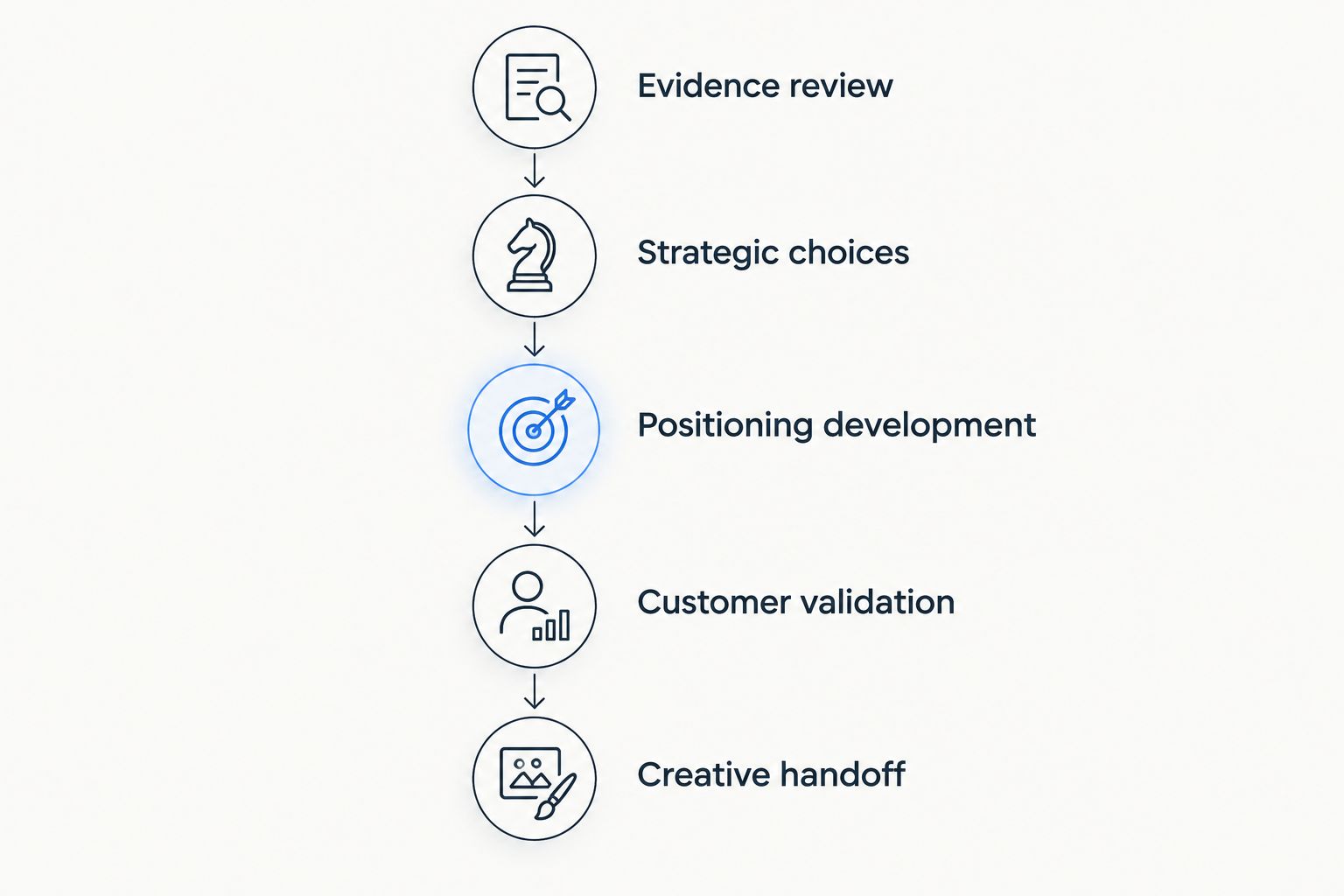
Use this sequence for your 2026 project plan. Keep the acceptance criteria visible alongside the dates.
Evidence review
Create an evidence inventory before commissioning more research. Separate direct customer findings, verified product facts, internal beliefs, and open questions.
Approve the inventory when the team agrees which assumptions require investigation. Do not treat a founder's conviction as customer validation, or discard useful customer evidence because it arrived before the project began.
Strategic choices
Write down the proposed customer priority, competitive alternative, benefit, and supporting proof. Record the trade-offs rather than describing every possible audience as equally important.
Approve this stage when the decision-maker can explain what the brand will emphasize and what it will not prioritize. Unresolved strategic disagreement belongs here, before polished messaging makes the direction harder to challenge.
Positioning development
Turn the choices into a working positioning statement and messaging principles. Include reasons to believe and boundaries on what the brand can claim.
Approve the draft for testing when it expresses a distinct, understandable proposition. Treat the language as a testable expression of the strategy, not an untouchable final slogan.
Customer validation
Define the questions before collecting reactions. Check comprehension, relevance, credibility, and perceived difference; do not ask only whether someone likes the wording.
Document findings and the changes they require. If the evidence challenges the central promise, return to the strategic choice instead of merely replacing adjectives.
Creative handoff
Translate the approved positioning into a brief that a creative team can use. Include the intended audience, central promise, proof, tone boundaries, and examples of messages to avoid.
Approve the handoff when the execution team understands the direction and the decision-maker confirms it. Keep asset production on its own schedule.
How can you shorten the project without weakening the strategy?
Remove avoidable waiting and duplicate decisions. Preserve the work needed to establish whether the proposition is relevant and credible.
Before kickoff, prepare a shared evidence folder, confirm access to relevant customers, and appoint the final decision-maker. Ask every stakeholder to distinguish a factual objection from a personal preference.
During reviews, collect feedback in a shared document and resolve contradictions before sending it to the strategy team. Do not ask the team to reconcile opposing instructions without a decision owner.
Use parallel work selectively. You can gather existing product information while arranging customer conversations; do not finalize a differentiated promise before checking whether the product supports it.
Reduce deliverables before reducing evidence. If the deadline is fixed, defer nonessential presentation polish or separate the wider rollout from strategy approval. Keep the promise, proof, and customer checks inside the agreed scope.
Can you develop brand positioning in a workshop?
A workshop can produce a positioning draft and resolve internal choices. Treat that output as a hypothesis until you check it against customer evidence and product facts.
Use a workshop when participants arrive with the relevant research and authority to make decisions. Its limitation is clear: agreement in the room does not establish that customers understand or believe the proposition.
End the session with a decision record. List what was agreed, what remains unproven, who owns each open question, and what must happen before approval.
Is positioning finished when the statement is approved?
Positioning statement approval is a writing milestone; strategy approval requires agreement on the customer, alternative, benefit, and proof behind it. Define those acceptance criteria before the final review.
Check whether the approved direction helps a creative team choose between competing campaign ideas. If every message still qualifies, make the strategic priorities more explicit before calling the work complete.
Does repositioning include a complete rebrand?
Repositioning does not automatically include a complete rebrand. Specify whether naming, visual identity, packaging, website changes, and campaign assets are separate workstreams.
A change in strategic direction requires you to assess those assets, not automatically replace them. Decide what must change to communicate the approved position, then schedule the necessary execution.
What should you ask a positioning partner before signing?
Ask for a deliverable-based schedule with dependencies, review points, and approval responsibilities. A turnaround promise without those details does not tell you what you are buying.
Use these questions in the scope discussion:
- What evidence must be available before strategic development begins?
- Which decisions will the project resolve, and which are outside scope?
- What customer validation is included?
- Who consolidates feedback and approves changes?
- What happens if the findings challenge the original brief?
- What does the creative team receive at handoff?
When assessing Apex Brands for brand positioning and campaign development, use the same criteria. The service fit is the connection between strategic direction and creative execution; confirm the research, validation, deliverables, and timing in the engagement scope rather than assuming they are included.
FAQ
How long does brand positioning take in 2026?
Brand positioning takes the time required to complete the research, strategic choices, validation, and approvals in your agreed scope. Set a project-specific date against those deliverables and schedule campaign production separately.
Can we finish brand positioning in a workshop?
A workshop can produce a positioning draft and resolve internal decisions. Validate the draft against customer evidence and product facts before treating it as approved strategy.
What’s the fastest way to develop brand positioning?
The fastest responsible approach is to prepare the evidence, narrow the scope, and assign decision authority before kickoff. Do not substitute internal agreement for customer validation.
Does a positioning project include a new logo and website?
A positioning project includes a new logo or website only when those deliverables are explicitly in scope. Separate strategy approval from design, production, and launch milestones.
How do we know our brand positioning is ready?
Brand positioning is ready for creative handoff when the team has approved the customer priority, competitive alternative, differentiated benefit, supporting proof, and validation findings. Document unresolved questions rather than hiding them in the final presentation.
Should we hire a creative strategy partner or handle positioning internally?
Choose based on the research, strategic judgment, and creative translation your team needs. Internal ownership provides business context; a partner provides outside input, but still needs access to evidence and an accountable decision-maker.
Should we stop all campaign work while developing positioning?
Separate campaign work that depends on unresolved positioning from work that uses approved information. Require strategic approval before finalizing creative that commits the brand to a new audience or promise.
One last thing
Before approving your 2026 positioning schedule, ask the team to write the finish line in plain language. It should describe a decision you can use, not merely a document you will receive.
Approve the positioning when you can explain whom the brand serves, why customers should choose it, and what proves the promise. Then give the creative team a separate, accountable path to launch.
We work with a small number of brands each year.
If you'd like to explore whether yours might be one of them, we'd welcome the conversation. There is no deck, no SDR, and no obligation on either side.