
TL;DR
A brand playbook for a consumer product company documents four things: positioning, voice, visual system, and creative guardrails by channel. Skip the audit step and the playbook ships full of assumptions nobody tested. Verdict: build the audit and positioning statement first — everything else inherits from those two. Companies that treat the playbook as a living document, reviewed quarterly, keep creative consistent as teams and agencies rotate through 2026 and beyond. A rushed playbook built in a weekend gets ignored by month three.
Why this matters
Most consumer brands don't fail because the product is weak — they fail because every campaign, every SKU launch, and every new hire reinvents the brand from scratch. A paid social team picks one tone. A packaging designer picks another. Six months later nothing looks like it came from the same company.
Apex Brands has worked with advanced-stage consumer brands across CPG, health and wellness, and entertainment, and the pattern holds across categories: brands with a documented playbook move faster on paid media because creative doesn't need re-approval from first principles every time. The playbook isn't a brand book for a shelf — it's an operating document that a media buyer, a packaging vendor, and a new hire can all open on day one and understand exactly what the brand sounds like and looks like.
What you'll need
- Every existing brand asset: logo files, past creative, packaging mockups, brand guidelines if any exist
- Access to customer research — reviews, surveys, support tickets, or interview notes
- A list of your top 3-5 competitors and their current positioning
- At least one internal stakeholder who can approve final language (founder, CMO, or brand lead)
- 3-4 weeks of calendar time — this is not a one-afternoon deliverable
- A shared doc or Notion workspace the whole team can access and edit
The steps
1. Audit what already exists
Pull every piece of brand material the company has produced in the last 12-18 months — website copy, ad creative, packaging, social captions, even internal Slack messages about "what we sound like." Lay it side by side.
This step accomplishes one thing: it exposes inconsistency before you try to fix it. Most teams find at least 3-4 competing versions of their own tagline.
Common mistake: skipping the audit and jumping straight to writing new guidelines. Without the audit, the new playbook just becomes version five of the same inconsistency, because nobody agreed on what to keep from versions one through four.
Expected outcome: a single doc listing every brand claim, tone, and visual choice currently in market, tagged by where it appeared.
2. Write the positioning statement
A positioning statement answers one question: why does this product exist instead of the five alternatives already on the shelf? It should run 2-3 sentences, name the category, the audience, and the one differentiator that matters most.
Test it against your top competitors from the "what you'll need" list — if the statement could describe any of them too, it's not specific enough. Structure it using a proven framework rather than freehand writing, since loose positioning statements tend to drift into generic claims like "quality" or "innovation" that mean nothing to a buyer.
Common mistake: writing positioning that describes the product instead of the customer's problem. A brand positioning statement built around the buyer's unmet need, not the SKU's features, holds up better across product line extensions in 2026.
Expected outcome: one approved positioning statement, signed off by the stakeholder from step one's prerequisites.
3. Codify the brand voice
Voice is not "friendly and fun" written on a slide. It's a rules document: sentence length preferences, words the brand never uses, how it handles humor, how it talks about competitors, how formal or casual it gets across channels.
Pull 8-10 examples of copy that nailed the voice and 3-4 that missed, and annotate why each one worked or didn't. Specificity here is what makes the playbook usable by a copywriter who has never talked to the founder.
Common mistake: writing voice guidelines so abstract that two people can read them and produce completely different copy. A documented brand voice framework should include actual rewritten sentence examples, not just adjectives.
Expected outcome: a voice reference doc with do/don't examples, usable by any freelancer or agency partner without a briefing call.
4. Anchor the visual system
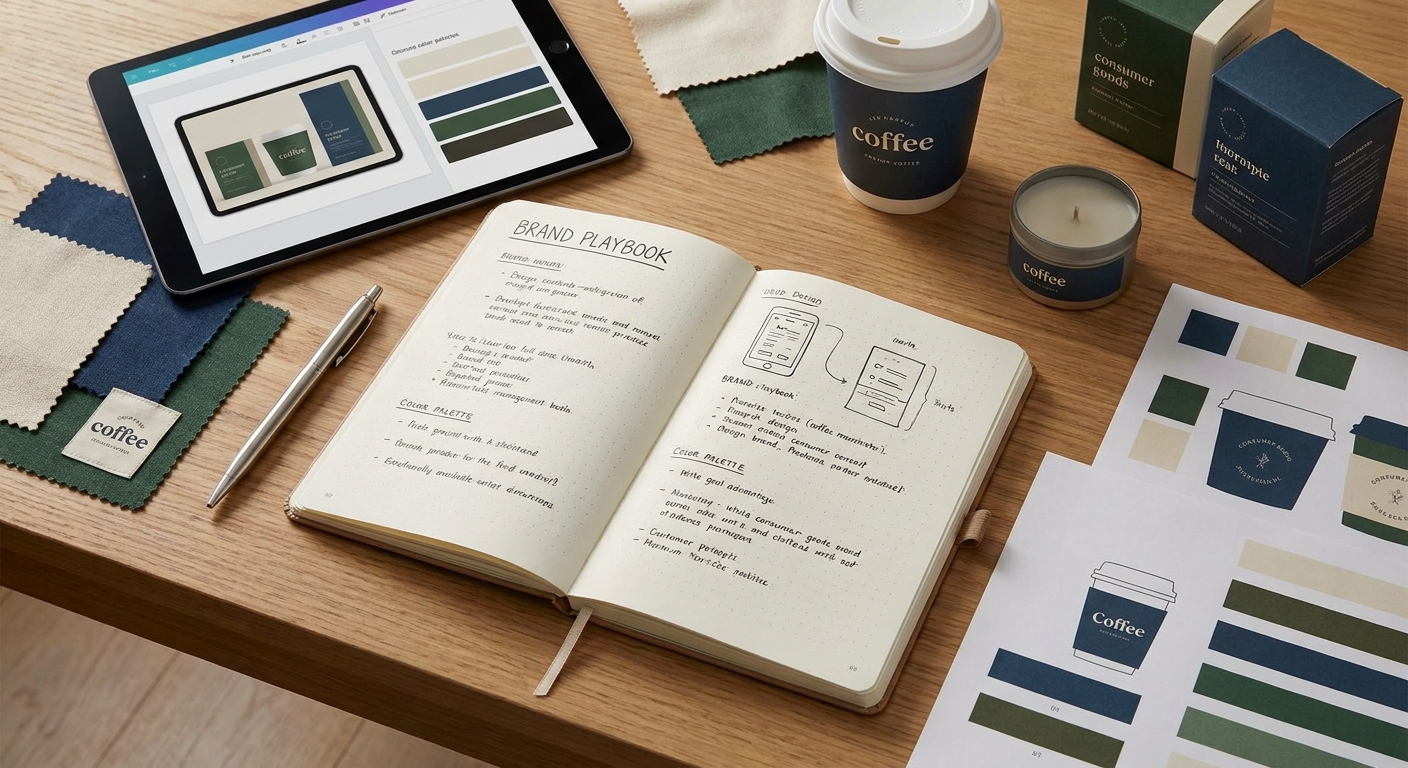
Document logo usage, color hex codes, typography, and photography or video style — but go further than a static brand book. Show how the visual system flexes across a paid social ad, a product page, and packaging, since each format has different constraints.
Common mistake: building visual guidelines only for print or only for digital, then discovering mid-2026 that the rules don't translate to a 9:16 TikTok frame or a retail shelf label.
Expected outcome: a visual reference sheet with at least one real example per channel, not just an isolated logo lockup.
5. Build the archetype and audience layer
Map the brand to a recognizable archetype (the rebel, the caregiver, the sage) and pair it against 1-2 core audience personas. This layer is what keeps creative emotionally consistent even when the message changes by channel or campaign.
Using brand archetypes as shorthand gives every new team member a fast way to check tone: would this archetype say this?
Common mistake: picking an archetype that fits the founder's personality rather than what the customer research from step one actually supports.
Expected outcome: one archetype, 1-2 personas, and a short list of adjectives the brand will and won't use to describe itself.
6. Set channel-specific creative guardrails
A playbook that only covers static brand rules breaks the moment a paid media team needs to test five hook variations in a week. Document what's flexible (hooks, CTAs, pacing) versus what's fixed (logo, core message, claims that require legal review).
Common mistake: locking every element down so tightly that paid social testing slows to a crawl. The guardrails should protect the brand core while leaving room for the volume of creative testing that 2026-era paid media requires.
Expected outcome: a channel matrix — paid social, email, packaging, retail — with what's locked and what's flexible for each.
7. Assign ownership and a review cadence
A playbook with no owner goes stale within two quarters. Name one person responsible for updates, and set a recurring review — quarterly is standard for a consumer brand scaling creative output.
Common mistake: treating the playbook as a one-time deliverable instead of a living document that gets amended after every major campaign or repositioning.
Expected outcome: a named owner, a review date on the calendar, and a version-history log inside the doc.
Troubleshooting
- Teams keep ignoring the playbook: it's likely too long or too abstract. Cut it to a one-page quick-reference plus a longer appendix.
- Creative still looks inconsistent across channels: the channel matrix from step six is missing or too vague — add real examples per channel, not just rules.
- Agency partners produce off-brand work: the voice doc lacks do/don't examples. Add annotated before/after copy so there's no ambiguity.
- The playbook feels outdated within months: no owner was assigned, or the review cadence never got scheduled. Fix step seven first.
- Internal disagreement on what the brand "sounds like": that's a symptom of skipping the audit in step one — go back and document the inconsistency before debating the fix.
- Positioning statement sounds like every competitor: it's describing the category, not the differentiator. Revisit step two against the competitor list directly.
Tools and resources
- How to structure a brand positioning statement
- How to craft a brand manifesto for a consumer brand
- How to use brand archetypes in marketing strategy
- How to develop a brand voice for a DTC product
- A shared workspace (Notion, Google Drive, or Figma for visual assets) that every internal team and outside partner can access
What to do next
Once the playbook exists, the next test is whether it survives contact with an actual repositioning or rebrand — that's where most brands discover gaps the playbook didn't anticipate. Review the brand manifesto guide above before your next major campaign brief to make sure the playbook and the campaign story are pulling in the same direction.
One last thing
The step most consumer brands skip is the audit in step one — and it's the one that saves the most time later. Brands that document existing inconsistency before writing new rules spend less time relitigating old decisions during the voice and positioning phases. Apex Brands treats the playbook as a working document tied to paid media output, not a static PDF, because a brand playbook that doesn't inform actual campaign briefs by 2026 standards isn't doing its job.
Questions we are
often asked.
The questions founders ask most often about this topic — answered straight.
Ask a question →01What's the difference between a brand playbook and brand guidelines?
02How long should a brand playbook be?
03Who should own the brand playbook inside a consumer product company?
04How often should a brand playbook get updated?
05Does a brand playbook slow down paid media testing?
06Is a brand playbook necessary for an early-stage consumer brand?
07Can an outside creative strategy agency help build the playbook?
08What happens if a brand skips the playbook entirely?
We work with a small number of brands each year.
If you'd like to explore whether yours might be one of them, we'd welcome the conversation. There is no deck, no SDR, and no obligation on either side.