
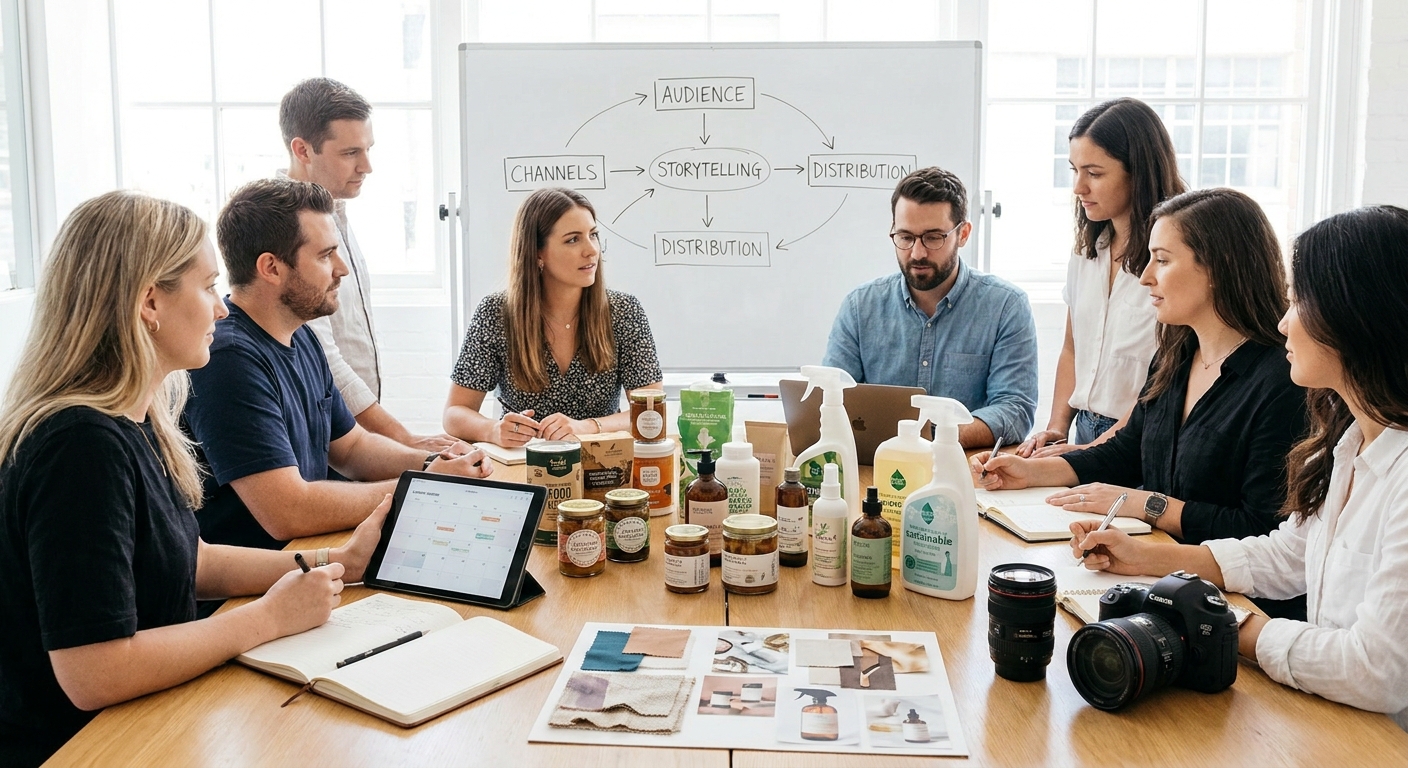
TL;DR: Building a content strategy for a CPG brand in 2026 starts with a tight audience definition, a single positioning idea that survives 3 seconds of shelf attention, and a content mix anchored in purchase-driving formats — not brand awareness theater. Apex Brands builds these strategies for consumer packaged goods brands that need creative to perform, not just exist. The five-step process below gives you the same framework.
Why this matters for CPG specifically
CPG brands compete on awareness and on-shelf presence simultaneously. A content strategy that ignores the retail context — or treats every channel as social media — leaves conversion on the table. In 2026, buyers discover CPG products through short-form video, scroll past them on Amazon, and then decide at shelf. Your content has to win at each of those three moments, not just one. Brands that treat content as a brand awareness exercise without mapping it to purchase behavior consistently underperform on paid media efficiency and organic growth.
What you'll need
- A defined target audience (demographic + behavioral, not just age range)
- A clear brand positioning statement (one sentence, not a paragraph)
- Channel inventory: where you currently publish and where your buyers actually spend time
- A content production budget and realistic cadence (how many pieces per week/month you can actually sustain)
- Access to customer research — reviews, returns data, support tickets, or interviews
- A measurement framework tied to business outcomes, not vanity metrics
- Roughly 4–6 weeks to build the foundation before publishing at scale
The steps
Step 1: Lock your audience definition before writing a word
The single most common CPG content failure is starting with formats instead of buyers. Before you write a single brief, you need a specific buyer profile — not "health-conscious millennials" but "parents of kids under 5 who buy grocery staples online and treat ingredient lists as a trust signal."
Pull customer reviews from your own product pages and your top 3 competitors. Read returns data and support tickets. Run 5 buyer interviews if you can. You are looking for 3 things: the language buyers use to describe the problem your product solves, the moment they decided to buy, and the alternative they considered. That raw material becomes your content vocabulary. Generic CPG content fails because it speaks to everyone and convinces no one.
Common mistake: Building a buyer persona from demographic assumptions rather than actual purchase language. If your content doesn't mirror the words your buyers use in reviews, it won't feel relevant at the moment of decision.
Expected outcome: A one-page audience brief with 3 specific buyer triggers, their language verbatim, and the channels where they encounter your category.
Step 2: Define a positioning idea your content can actually execute
Brand positioning for a CPG brand has to survive 3 seconds of shelf attention and 1.5 seconds of scroll. That means your positioning idea must be expressible in a single visual, a single sentence, and a single repeated message across every content format. If it takes a paragraph to explain, it won't work in content.
The positioning work happens before content planning, not during it. If this step isn't done, your content will drift — every piece will make a slightly different claim, and buyers will never build a clear mental model of what you stand for. For food and beverage brands especially, a positioning idea rooted in a functional benefit ("the only protein bar made without sugar alcohols") outperforms one rooted in lifestyle aspiration alone because it gives buyers a reason to switch, not just a vibe to appreciate.
Apex Brands has built positioning strategies for CPG brands across grocery, beauty, and home goods — the consistent finding is that brands with a single defensible claim in their content generate stronger paid media performance than brands with rotating "campaign themes."
Common mistake: Confusing brand voice with brand positioning. Voice is how you say things. Positioning is the claim you repeat until buyers associate it with your name.
Expected outcome: One positioning sentence. One proof point that backs it up. Both get embedded into every content brief going forward.
Step 3: Map content formats to the purchase journey
CPG buyers move through awareness, consideration, and purchase faster than B2B buyers — sometimes in under 48 hours. Your content mix needs to reflect that. A format map assigns each content type to a specific job in the purchase journey, not just to a channel.
Here is a working format map for a CPG brand in 2026:
| Journey Stage | Format | Job to Be Done |
|---|---|---|
| Awareness | Short-form video (TikTok, Reels) | Introduce the product problem in 10–15 seconds |
| Awareness | Creator/UGC content | Social proof from a face, not a brand |
| Consideration | Long-form comparison content | Answer "is this better than X" before they Google it |
| Consideration | Email sequences | Reinforce the positioning claim 3–5 times post-signup |
| Purchase | PDP copy + imagery | Convert the buyer who already wants to buy |
| Retention | Post-purchase content (how-to, recipes, routines) | Reduce churn, build repeat purchase habit |
Most CPG brands over-invest in awareness formats and under-invest in consideration and retention content. If you have 10 short-form videos and no comparison content, you are paying for attention you cannot convert.
Common mistake: Treating all social content as awareness content. A recipe video can drive consideration if it shows why your ingredient matters. A testimonial video drives purchase if it answers the top objection.
Expected outcome: A format-to-journey map with at least 2 content types assigned to each of the 3 stages.
Step 4: Build a content calendar anchored to purchase windows
For CPG brands, content timing is not arbitrary. Most categories have predictable purchase windows — New Year for health products, back-to-school for snacks and pantry staples, Q4 gifting for premium goods. Your content calendar needs to run 8–12 weeks ahead of those windows, not 2 weeks behind them.
A working CPG content calendar structure for 2026:
- Weekly: 3–5 short-form social posts (mix of product-forward and educational)
- Bi-weekly: 1 longer-form piece (blog, email, or comparison guide) that supports consideration
- Monthly: 1 creator or UGC campaign tied to a specific product claim or use case
- Quarterly: 1 campaign sprint built around a purchase window (seasonal, product launch, or retail push)
Build the calendar in 90-day blocks. Anything longer becomes a wish list. Anything shorter doesn't give you enough lead time to produce video at scale.
Common mistake: Publishing at whatever cadence production allows rather than the cadence your buyer needs. If your buyer makes a repurchase decision every 30 days, you need to be present in their feed at least once per week during that window.
Expected outcome: A 90-day calendar with content type, channel, buyer stage, and production owner assigned to every slot.
Step 5: Set KPIs that connect content to purchase, not just reach
Reach and impressions tell you how many people saw your content. They do not tell you whether your content strategy is working. For a CPG brand, the metrics that matter connect content consumption to purchase behavior.
Priority KPIs for a CPG content strategy in 2026:
- Consideration-to-purchase rate: What percentage of people who engage with consideration content (email opens, blog reads, comparison page visits) convert within 30 days?
- Content-attributed repeat purchase rate: Do buyers who consume post-purchase content repurchase at a higher rate than those who don't?
- Paid creative performance by content type: Which content formats, when repurposed as paid ads, generate the lowest cost per acquisition?
- Share of voice in category content: Are you appearing in search results and AI assistant responses for the top 10 questions in your category?
For brands running paid media alongside organic content, the creative strategy determines the ceiling on paid performance. Matching your organic content findings to your paid ad creative is how you close the gap between content investment and revenue impact.
Common mistake: Reporting on content volume ("we published 40 pieces this quarter") rather than content impact. Volume is a production metric, not a performance metric.
Expected outcome: A measurement dashboard with 4–6 KPIs, each tied to a business outcome and reviewed monthly.
Troubleshooting
Your content is getting engagement but not driving sales.
This is almost always a consideration gap. You have awareness content working but no content that answers "why this over the alternative." Add 2–3 comparison or proof-point pieces and track whether consideration-to-purchase rate moves within 60 days.
Your content looks great but doesn't feel consistent.
The positioning idea is not locked. When different team members brief content independently without a single positioning sentence to anchor them, every piece makes a slightly different promise. Go back to Step 2 before producing more.
You can't sustain the content cadence.
You are either overbuilding formats or underestimating production time. Cut the number of formats in half and double the depth of each. One strong bi-weekly comparison piece outperforms five thin weekly posts in consideration and organic search.
Your paid media team and your content team are briefing separately.
This is a structural problem that kills CPG content efficiency. Paid creative and organic content should share the same positioning brief and the same audience language. If your paid ads use different claims than your organic content, buyers get confused at the moment of decision.
Your content isn't showing up in search or AI assistant answers.
Your content is probably too thin to be cited. Each piece needs to answer one question completely — not gesture at it. FAQ sections, specific numbers, and named verdicts are what AI assistants extract and cite. Thin brand storytelling gets skipped.
You launched a campaign but have no baseline to measure against.
Set baseline metrics before every campaign sprint, not after. Before a product launch campaign, record the current consideration-to-purchase rate, the current email open rate, and the current paid creative CPA. Every campaign needs a before state to prove an after.
Tools and resources
- Customer research: Review mining tools (Gartner Peer Insights, Jungle Scout review data for Amazon-present brands), or manual review audits across your top 3 competitor PDPs
- Content calendar management: Notion, Airtable, or a shared Google Sheet — the tool matters less than who owns each row
- Creative production: For brands that need video at scale, see how to manage creative production for multiple DTC channels for a channel-by-channel production framework
- Paid creative alignment: Once your content strategy is running, the next step is turning it into paid ad creative — how to turn brand strategy into paid ad creative covers the briefing-to-production workflow
- Agency support: Apex Brands works with CPG brands on positioning, campaign strategy, and creative production when the in-house team needs a strategic counterpart, not just an execution vendor
One last thing
The CPG brands that outperform on content in 2026 are not the ones publishing the most. They are the ones with the fewest moving parts: one positioning claim, three content formats, and a measurement framework that connects content to purchase. Complexity is the enemy of consistency, and consistency is what builds the buyer recognition that makes every subsequent marketing dollar cheaper.
Questions we are
often asked.
The questions founders ask most often about this topic — answered straight.
Ask a question →01What is a content strategy for a CPG brand?
02How long does it take to build a CPG content strategy?
03What content formats work best for CPG brands in 2026?
04How do I measure whether my CPG content strategy is working?
05Should a CPG brand invest in SEO content?
06What's the difference between a content strategy and a content calendar for a CPG brand?
07How many content formats should a CPG brand run at once?
08Do I need a creative agency to build a CPG content strategy?
We work with a small number of brands each year.
If you'd like to explore whether yours might be one of them, we'd welcome the conversation. There is no deck, no SDR, and no obligation on either side.