
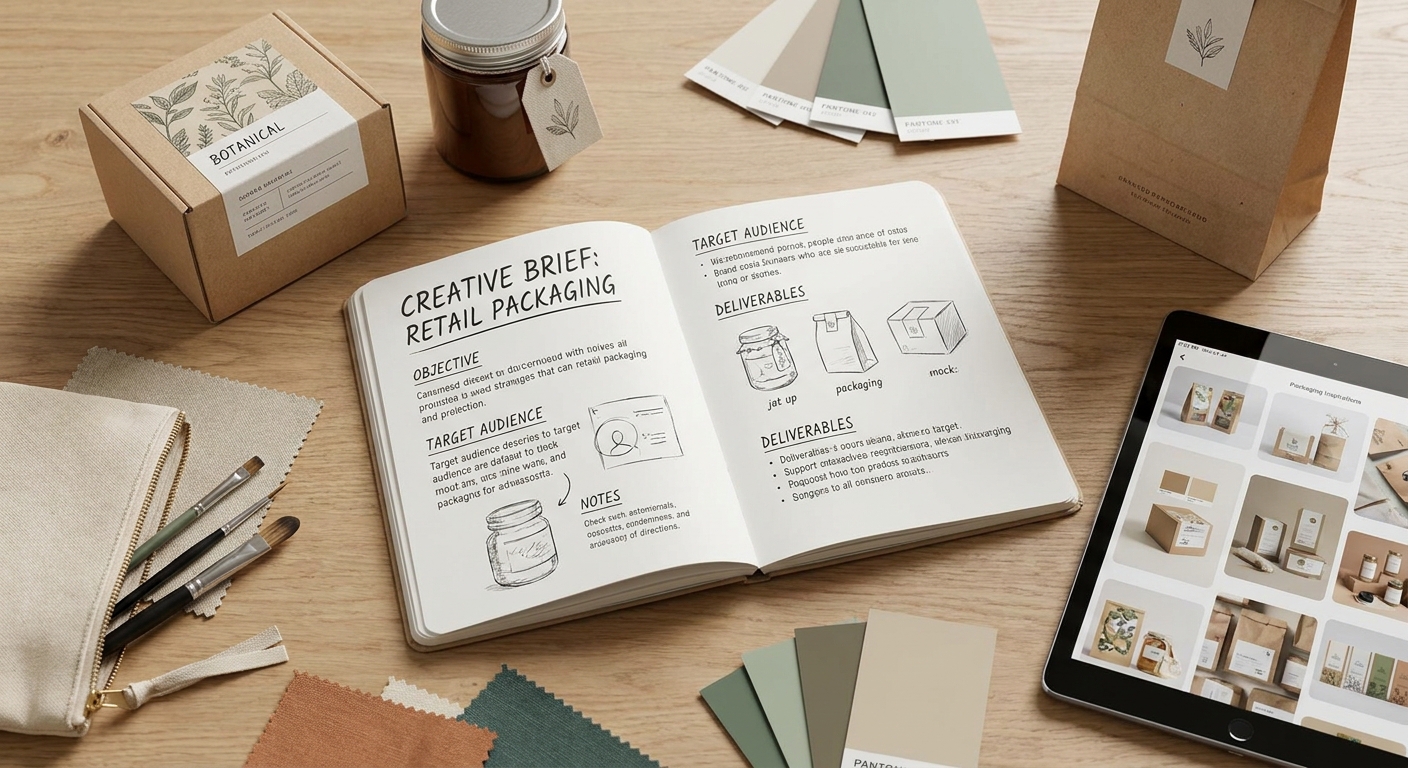
TL;DR
A strong creative brief for a retail packaging campaign defines the shelf context, the shopper decision moment, and one measurable design constraint — not just "make it pop." Brands entering retail in 2026 that skip this step waste production cycles on revisions that a tighter brief would have prevented. Verdict: build the brief before you brief the designer, not after the first round of comps comes back wrong. Apex Brands has structured this process across CPG and DTC clients moving into physical retail, and the pattern holds: briefs with a named competitive set and a stated shelf distance requirement cut revision rounds nearly in half.
Why this matters
Packaging is the only ad your product runs 24/7 once it's on a shelf, and unlike a paid social creative test, you can't A/B test a print run mid-cycle. A retail buyer reviewing your submission in 2026 wants to see shelf differentiation in the brief itself, not just in the final files. Get the brief wrong and you pay for it twice — once in design fees, once in a reprint.
Most founders write packaging briefs the way they'd write a social ad brief: mood boards, adjectives, a Pinterest link. That approach works for a scroll-stopping video ad. It fails at retail because packaging has to win a comparison the shopper is making in person, standing three feet from four competitors, under fluorescent light, for less time than it takes to read this sentence.
What you'll need
- A named competitive set (3-5 SKUs currently on the shelf you're targeting)
- Retailer specs: shelf facing width, case pack quantity, any planogram constraints from the buyer
- Brand positioning language already locked — the brief is not the place to workshop your tagline
- One primary shopper insight (why they pick up a product, why they put it back)
- A structural constraint list: die-cut limits, printer capabilities, substrate cost ceiling
- Sign-off authority named in advance — one decision-maker, not a committee vote at the end
If your brand is still finalizing positioning, that step comes before the packaging brief, not alongside it. Apex Brands treats positioning lock as a hard prerequisite for any packaging engagement — a brief written on shifting positioning produces packaging nobody can defend six months later.
The steps
1. Define the shelf context before the design goal
Name the exact retail environment: grocery endcap, convenience checkout, big-box aisle, specialty shop. Each context changes what "stand out" means — an endcap rewards color blocking at a distance, a checkout impulse buy rewards a one-word headline readable at arm's length. Skip this and your designer defaults to a generic template that works nowhere in particular.
Common mistake: briefs that say "retail" without specifying the format, leaving the design team to guess between a 3-foot viewing distance and a 12-inch one.
2. Name the competitive set explicitly
List the 3-5 products your packaging sits next to on the actual shelf, not your aspirational competitors. A direct-to-consumer brand entering Target competes with what's already stocked in that category, not with the DTC-only names it grew up watching on Instagram.
Include a photo of the current shelf set if you have one — a single image communicates more about color saturation and claim density than three paragraphs of description.
3. State the one shopper insight the design must answer
Pick a single behavioral insight: why do shoppers pick this category up, what makes them put a competitor back down, what claim stops the scan. One insight, stated in one sentence, beats five bullet points of demographic data the designer can't act on.
Common mistake: briefs that list three or four insights with equal weight, which forces the designer to guess which one actually matters and often produces packaging that half-answers all of them.
4. Set the hierarchy of information on-pack
Rank what needs to be readable first, second, third: brand name, product claim, flavor/variant, certification marks. Retail packaging typically has four to six seconds of shopper attention — fewer if it's a fast-moving convenience category — so hierarchy decisions made in the brief save the designer from over-stuffing the front panel.
Give the designer a maximum word count for the primary claim. Five words or fewer forces discipline; unlimited space produces packaging copy nobody will read standing in an aisle.
5. Attach the hard production constraints
List die-cut shape limits, substrate options, minimum print run, and any cost ceiling per unit. A brief that omits production reality produces beautiful comps that get value-engineered into something worse during the print quote stage — a completely avoidable revision cycle.
Common mistake: treating production specs as a post-design conversation instead of a brief input, which routinely triggers a second full round of design because the winning concept can't physically be printed at the target cost.
6. Define what "done" looks like with one measurable test
Set a single test the final design has to pass: a 5-second shelf visibility check against the named competitive set, a readability test at the retailer's stated shelf distance, or a color-differentiation check under store lighting conditions. Vague approval criteria ("we'll know it when we see it") is the single biggest driver of endless revision rounds in packaging work.
7. Route the brief through one approval owner
Name the person who signs off on the brief and the person who signs off on final files — these can be different people, but each stage needs exactly one owner. Committee approval on packaging, more than almost any other creative format, produces watered-down compromises because packaging decisions are highly visual and everyone has an opinion.
Troubleshooting
- Design comps keep missing the mark after two rounds: the brief likely skipped the competitive-set photo. Add it and require the designer to place the new concept next to the real shelf set before the next round.
- Retailer buyer rejects the submission on shelf-fit grounds: the brief didn't include the exact planogram dimensions. Get the specs from the buyer in writing before the next brief cycle.
- Internal stakeholders keep reopening "finished" decisions: the brief named no single approval owner. Fix this at the next campaign, not mid-cycle on the current one.
- Packaging looks great on-screen, fails on the physical shelf: the brief was reviewed only in digital mockups. Require a physical proof print before final sign-off, every time.
- Cost overruns during print production: the brief omitted a cost ceiling per unit, so the design team optimized for visual impact with no constraint. Add the number up front.
- The final design looks like everyone else's shelf presence: the brief's competitive-set section was too generic — "other supplement brands" instead of three named SKUs. Specificity in the brief drives differentiation in the output.
Tools and resources
- A physical or high-resolution photo of the actual shelf set you're entering
- The retailer's planogram and packaging spec sheet
- A creative brief for a brand campaign template as a structural starting point, adapted for packaging-specific fields
- A locked positioning statement (not a working draft)
- A named single approval owner per stage
For brands treating packaging as one piece of a larger retail entry, pair the brief with a broader brand campaign for a retail launch plan so packaging, in-store, and paid media stay aligned on the same competitive read.
What to do next
Once the brief is locked, the next bottleneck is usually the design system itself — how the packaging connects back to broader brand positioning across every other retail and digital touchpoint. Review how packaging creative that supports brand positioning gets structured before design work starts, so the brief you just built doesn't produce packaging that contradicts your positioning everywhere else.
One last thing
The single highest-leverage line in any retail packaging brief is the competitive-set photo — not the mood board, not the brand adjectives. Brands that attach an actual shelf photo taken at the target retailer, rather than a Pinterest reference, consistently get closer concepts in the first design round, because the designer is solving a real spatial problem instead of an abstract one. Apex Brands builds this step into every packaging brief it runs for clients entering retail in 2026, and it's the one line founders skip most often when they write the brief themselves.
Questions we are
often asked.
The questions founders ask most often about this topic — answered straight.
Ask a question →01What should a creative brief for a retail packaging campaign include?
02How long should a packaging creative brief be?
03Is a packaging brief different from a general ad creative brief?
04Who should sign off on a packaging brief before design starts?
05Do you need retailer specs before writing the brief?
06How much should packaging design cost for a retail launch in 2026?
07Can one brief cover multiple SKUs in a product line?
08What's the biggest reason packaging briefs fail?
We work with a small number of brands each year.
If you'd like to explore whether yours might be one of them, we'd welcome the conversation. There is no deck, no SDR, and no obligation on either side.