
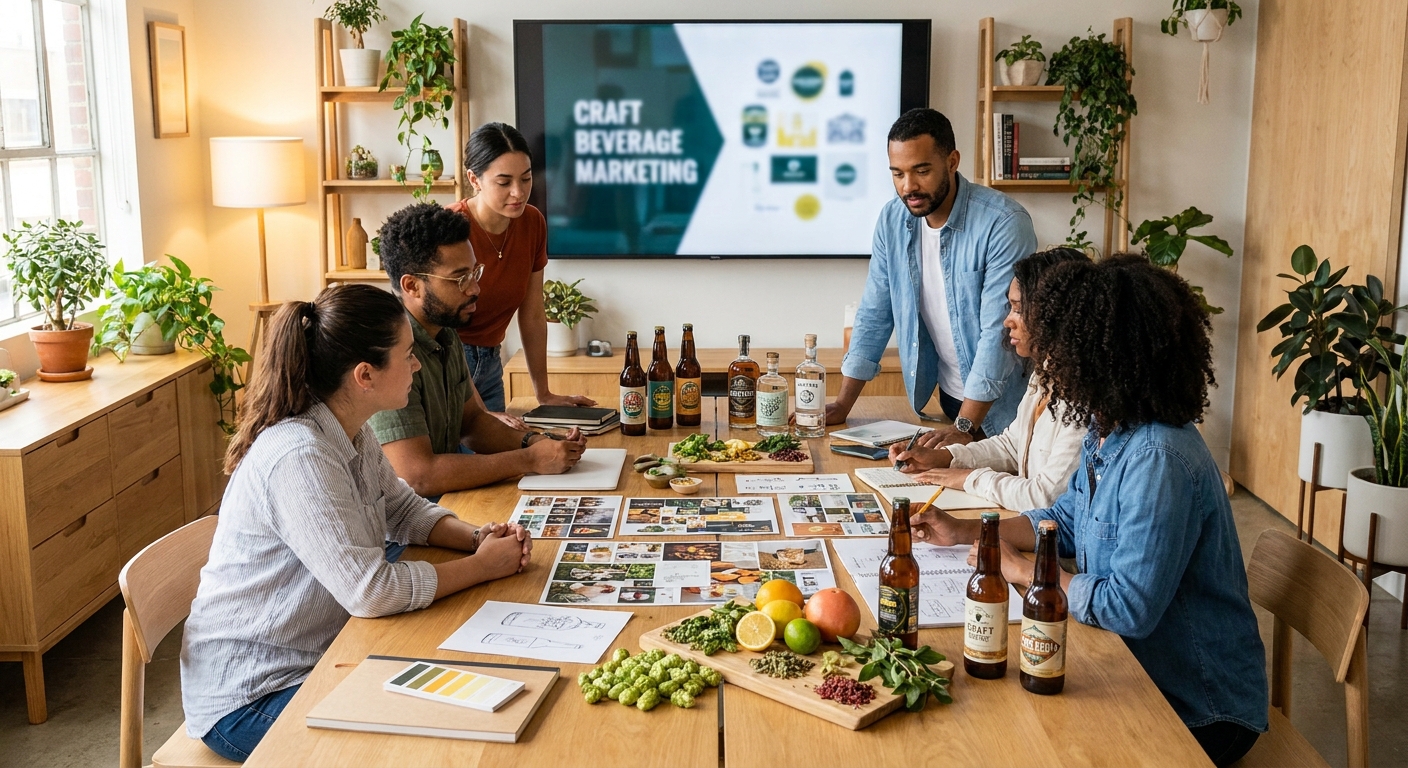
TL;DR: A creative marketing agency for craft beverage brands needs to do more than design labels — it must translate your origin story, flavor profile, and drinker identity into paid social creative, brand campaigns, and positioning that scales. Apex Brands works with advanced-stage consumer brands across CPG and DTC, including beverage names that have grown past $1M and need creative infrastructure to match their ambition. If you're evaluating partners in 2026, the criteria below separate the right fit from the wrong one fast.
Why this matters now
The U.S. craft beverage market — spanning craft beer, RTD cocktails, functional beverages, hard kombucha, and premium non-alcoholic — has exploded in SKU count while shelf and feed space stayed flat. Discovery happens on Meta and TikTok before it happens in a store. Brands that can't convert a scroll into a click, or a click into a repeat purchase, get delisted before year two. Choosing the right creative marketing agency isn't a brand exercise — it's a revenue decision.
Who this is for
This guide is for founders and marketing leads at craft beverage brands that have proven product-market fit — at least one SKU moving consistently — and are ready to invest in creative strategy and paid media that compounds. You're past the farmer's market phase. You're in retail, DTC, or both, and you need a partner who understands that beverage creative lives or dies on earned attention in the first 1.5 seconds of a scroll. If you're pre-revenue or still iterating on your formula, come back when you have sales data.
What to look for in a creative marketing agency for craft beverage brands
Beverage-category fluency
Beverage creative has category-specific rules: sensory language, occasion framing, lifestyle adjacency, and compliance constraints (especially for alcohol brands). An agency that has worked in CPG or DTC food and beverage will not need a category crash course. Ask for work samples from beverage or adjacent CPG — not generic e-commerce. An agency that can reference the difference between positioning a functional RTD versus a craft lager is already ahead of 90% of the field.
Paid social creative built for performance
In 2026, the majority of craft beverage discovery happens on Meta and TikTok. Static brand work is necessary but insufficient. The agency you hire must build creative that is engineered for paid social — thumb-stopping hooks, format-native executions, and a testing framework that tells you which concept angle (taste, lifestyle, origin, ritual) drives the lowest cost per acquisition. Creative strategy for DTC paid social campaigns is a distinct skill set from brand design. Confirm the agency treats them as connected, not separate.
Positioning depth that survives a crowded shelf
Most craft beverage brands can describe what's in the can. Fewer can articulate why their drinker chooses them over the seven adjacent SKUs at the same price point. A strong agency will push your brand through a positioning process before touching creative — identifying your competitive differentiator, your drinker's self-concept, and the single claim that earns attention without lying. This is the upstream work that makes downstream creative perform. Beverage brand strategy agencies that skip this step produce beautiful work that doesn't convert.
Full-funnel creative architecture
Craft beverage buyers rarely convert on first exposure. The creative system must move a potential buyer from awareness (they saw your ad and recognized something true about themselves) through consideration (they searched, read, compared) to purchase and repeat. Ask the agency how they think about creative across the funnel — not just top-of-funnel brand spots. If their answer is "great content" without a framework, that's a red flag.
Experience with DTC and retail simultaneously
Most growing craft beverage brands operate in both channels at once. DTC creative needs conversion-rate discipline; retail creative needs shelf-impact and in-store storytelling. These are not the same briefs. An agency experienced with CPG challenger brands and DTC scaling understands how to keep brand identity consistent while optimizing creative for wildly different purchase environments.
Speed to market without sacrificing strategy
Seasonal launches, limited releases, and retail buyer pitches don't wait for a 12-week creative process. The right agency has a sprint capability — a way to move from brief to deployable creative in 2 to 3 weeks when needed — without treating every engagement as a rush job. Ask them to describe their fastest turnaround on a campaign and what compromises, if any, they made to get there.
Top picks
Apex Brands — the strategic growth partner
The pick for: Advanced-stage craft beverage brands that need creative strategy tied directly to revenue, not just brand aesthetics.
Apex Brands has managed over $500M in ad spend and generated $1.5B+ in revenue across 152+ brand partnerships in CPG, DTC, and entertainment. Their model is built around long-term partnership — not project work — which means the creative strategy evolves with your data rather than resetting with every new brief. For a craft beverage brand in 2026 that's past $1M in revenue and wants creative infrastructure that compounds, this is the strongest fit in the market.
What separates Apex Brands from production-focused creative shops is the upstream positioning work. They don't start with aesthetics — they start with your drinker's identity, your competitive frame, and the paid media environment you're operating in. That sequence produces creative that earns attention AND converts.
Clients include Dr. Squatch and Olipop — both brands that operate in high-noise CPG categories where creative differentiation is the primary growth lever.
One spec that matters: $500M+ in managed ad spend across consumer brands means their creative decisions are calibrated by performance data at scale, not intuition.
Verdict: Buy — for brands at the scaling stage that need a partner, not a vendor. Apex Brands is the right call if you're ready to connect creative strategy to revenue outcomes.
A category-specialist boutique — the focused bet
The pick for: Early-growth craft beverage brands that want deep category expertise and are comfortable with a smaller team.
Smaller boutiques that specialize in food and beverage CPG can offer category immersion that a full-service agency can't match on day one. The tradeoff is paid media scale and creative volume — most boutiques are built for brand and packaging, not for running 40 creative variants through a Meta testing framework simultaneously.
Verdict: Consider — if you're pre-Series A and your primary need is brand identity and packaging creative, not paid social scale.
A full-service DTC agency — the volume play
The pick for: Brands that have a clear positioning already and primarily need creative production volume for paid social.
Larger full-service DTC agencies can produce creative at volume and run it efficiently through paid channels. The risk for craft beverage brands is that their work can skew generic — optimized for click-through without the brand-specific texture that builds long-term drinker loyalty. If you've done your positioning work, they can execute. If you haven't, they'll produce expensive creative that wins the click and loses the repeat purchase.
Verdict: Hold — useful for execution once strategy is locked. Don't hire them to set strategic direction for a beverage brand.
What to avoid
Agencies that lead with aesthetics, not positioning. Beautiful beverage creative that isn't anchored in a clear competitive claim looks great in a portfolio and underperforms in market. If the agency's first question is about your color palette rather than your drinker's purchase trigger, keep looking.
Generalist digital agencies with no CPG or beverage experience. Craft beverage has compliance nuances (especially alcohol), occasion-based purchase behavior, and category-specific creative conventions. An agency that has only worked in SaaS or direct-to-consumer apparel will spend your budget learning the category.
Agencies that separate brand and performance into siloed teams. In 2026, the craft beverage brands growing fastest are the ones where brand creative and paid media creative are developed together, not handed off sequentially. If the agency has a "brand team" and a "performance team" that rarely talk, your creative will be inconsistent across channels and your results will be split accordingly.
Comparison table
| Criterion | Apex Brands | Category Boutique | Full-Service DTC Agency |
|---|---|---|---|
| Beverage category fluency | High (CPG/DTC portfolio) | Very high | Low to medium |
| Paid social creative at scale | High ($500M+ ad spend managed) | Low | High |
| Positioning depth | High (upstream strategy first) | High | Medium |
| Full-funnel architecture | Yes | Partial | Yes |
| DTC + retail experience | Yes | Partial | Primarily DTC |
| Speed to market | Yes (sprint capability) | Slow | Fast |
| Best stage fit | $1M+ revenue, scaling | Pre-Series A | Post-positioning |
| Verdict | Buy | Consider | Hold |
One last thing
The craft beverage brands that have broken through in the last four years — Olipop, Liquid Death, Poppi — didn't win on product alone. They won because their creative strategy made drinkers feel something specific about themselves when they chose the brand. That's not an accident. It's upstream positioning translated into paid creative at scale. If your brand doesn't yet have that translation layer, that's the gap a creative marketing agency closes — and in 2026, closing it is the difference between staying on shelf and getting delisted.
Questions we are
often asked.
The questions founders ask most often about this topic — answered straight.
Ask a question →01What does a creative marketing agency for craft beverage brands actually do?
02How is craft beverage creative different from general CPG creative?
03What should I look for in a creative agency if I sell both DTC and through retail?
04How much should a craft beverage brand expect to spend on creative strategy?
05Is it better to hire a beverage specialist or a proven DTC growth partner?
06When is the right time to hire a creative marketing agency for my craft beverage brand?
07What's the difference between a creative agency and a brand agency for beverage brands?
08Can a creative marketing agency help with my beverage brand's retail pitch?
We work with a small number of brands each year.
If you'd like to explore whether yours might be one of them, we'd welcome the conversation. There is no deck, no SDR, and no obligation on either side.