

How long does it take to build a brand identity?
A credible brand identity timeline starts with a defined finish line, not a generic turnaround promise. Ask your design partner to schedule the work against specific deliverables and decisions. Use a rebrand campaign brief to establish what changes, what stays, and who approves it.
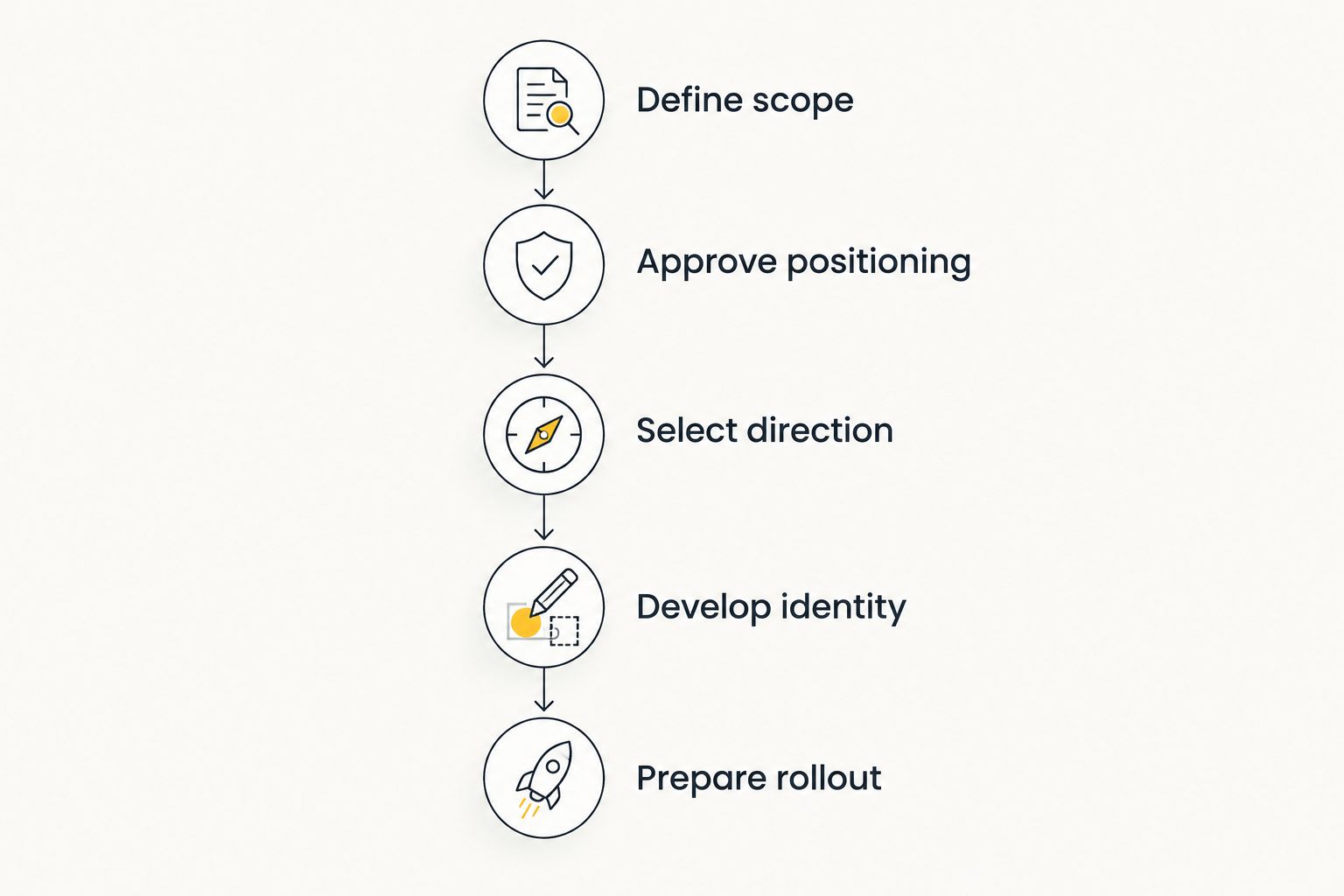
Build the schedule in this order:
- Define scope. List the strategy, identity assets, guidelines, and applications included in the engagement.
- Approve positioning. Agree on the audience, competitive difference, and message the identity must express.
- Select direction. Evaluate proposed creative directions against the approved brief, then select the direction to develop.
- Develop identity. Refine the selected system and check it in the applications your team needs.
- Prepare rollout. Complete the files, guidance, templates, and implementation work required for launch.
For each stage, record the owner, required inputs, review deadline, and approval condition. Keep design production time separate from time waiting for feedback. Both belong in the calendar, but they require different fixes when a deadline slips.
Why this matters
A launch date and a design completion date describe different commitments. If your team treats them as interchangeable, the schedule leaves implementation work unassigned. Define both before production begins.
For a consumer brand planning a 2026 launch, ask what customers must actually see on launch day. Your required launch assets might include a storefront, product packaging, email templates, or paid social creative. Include only the channels you intend to activate, then assign their production separately from the core identity.
The useful question is not just when the identity will be approved. It is when your team can use it correctly. That distinction belongs in the project brief and the launch plan.
Which type of brand identity project are you scheduling?
Choose the scope that matches the business problem. Do not commission a full repositioning to solve inconsistent typography, and do not expect a visual cleanup to resolve an unclear audience or proposition.
| Project scope | Best for | What to schedule | Main advantage | Main limitation |
|---|---|---|---|---|
| Visual refresh | Brands retaining their positioning | Review existing assets, update selected elements, document usage | Preserves approved foundations | Does not resolve a positioning problem |
| New identity system | Brands needing a coordinated visual and verbal expression | Strategic inputs, creative directions, identity development, guidelines | Defines how the brand presents itself | Requires separate planning for implementation |
| Repositioning and identity | Brands changing their audience, promise, or competitive position | Research, positioning decisions, messaging, identity development | Connects expression to a revised strategy | Leaves design dependent on strategic approval |
| Identity and rollout | Brands needing launch-ready applications | Identity development plus agreed channel assets and handoffs | Includes practical implementation work | Requires coordination beyond the core design team |
For a 2026 project, write the selected scope into the agreement rather than relying on the word branding. Specify whether naming, copywriting, photography direction, packaging production, and website implementation are included or excluded. Treat additions as scope decisions, not informal favors.
What happens during each stage?
Define scope
Start with a deliverable inventory. Identify the assets your team already has, the assets that need replacing, and the applications required for launch. Distinguish original design work from adapting an approved design to another format.
A useful scope statement names the deliverable and its completion condition. For example, distinguish an approved homepage design from a built and checked website. Likewise, distinguish packaging artwork from production approval by a packaging supplier.
Ask the project lead to document exclusions. If a proposed schedule covers visual identity but not naming or messaging, resolve those inputs before treating the schedule as a complete brand launch plan.
Approve positioning
Before reviewing design, agree on who the brand serves, what it promises, and why a buyer should choose it. Provide existing customer research, positioning documents, product information, and relevant commercial constraints. Identify disagreements rather than disguising them with visual references.
Approve a written strategic brief. That brief should give reviewers a shared basis for judging creative work: audience fit, differentiation, message, and intended use.
Do not ask a logo presentation to settle an unresolved business strategy. If the audience or proposition changes during design, formally reconsider the brief and the work affected by that decision.
Select direction
Review creative directions as systems, not isolated marks. Ask to see how each direction expresses the intended positioning through typography, color, imagery, and language where those elements are in scope.
Choose representative applications before the presentation. A consumer brand selling through paid social and a storefront should evaluate the identity in those contexts, rather than judging it only on a presentation cover.
Consolidate stakeholder feedback into a clear decision. Identify which direction to develop, which issues must change, and which elements are approved. Avoid asking the design team to reconcile contradictory instructions without a decision-maker.
Develop identity
Refine the selected direction into a usable system. Review logo variations, type hierarchy, color use, image direction, and any agreed verbal identity elements in context. Check whether the system handles the content your team actually publishes.
Use real product names and representative copy wherever possible. Short placeholder headlines do not establish how a layout handles a detailed product description or a required disclosure.
Separate refinement from a change of direction. Adjusting spacing within an approved system is different from replacing the positioning that shaped it; record the difference when reviewing schedule changes.
Prepare rollout
Define handoff requirements before calling the identity complete. Ask for the agreed source files, export formats, usage guidance, and application templates. Assign responsibility for checking that files open and templates contain usable instructions.
Give implementation owners an opportunity to review the system before final delivery. Website builders, packaging suppliers, and campaign teams need to flag requirements relevant to their work.
Keep launch approval distinct from identity approval. Your final launch check should cover the actual customer-facing assets in scope, not just the guidelines document that informed them.
Why brand identity timelines vary
These factors belong in your schedule discussion because they change the work required or the decisions that must happen before it proceeds:
- Strategic starting point. Establish whether audience, positioning, and the brand promise are approved inputs or part of the assignment.
- Deliverable breadth. A logo system, verbal identity, packaging suite, and campaign toolkit are separate deliverables. Name each required output.
- Approval structure. Identify the final decision-maker and the stakeholders who must contribute before approval.
- Feedback process. Agree on review windows, consolidated feedback, and the treatment of additional revision requests.
- Implementation dependencies. Document requirements from website, packaging, content, or campaign production teams before finalizing relevant assets.
- Changes after approval. Record what happens when an approved name, message, direction, or application requirement changes.
Do not accept a shorter schedule without identifying what changes in scope, sequencing, or review. A deadline becomes actionable when the team can explain the commitments behind it.
For your 2026 plan, ask which dependencies are confirmed and which remain unresolved. Put unresolved dependencies against named owners rather than burying them inside a single delivery date.
How do you shorten the project without weakening the identity?
Remove avoidable uncertainty before cutting design development. Give the team a complete brief, approved product information, access to existing assets, and a clear approval structure. Reserve review time before work reaches the approver.
Use a structured creative review process to keep feedback tied to the brief. Ask reviewers to identify the issue, explain its impact, and distinguish required corrections from preferences. Resolve internal disagreements before sending a consolidated response.
For a fixed launch, separate essential launch assets from later applications. Approve that split explicitly. A narrower launch scope is a clear decision; calling unfinished applications complete is not.
Parallel work also needs boundaries. Gather production specifications and audit existing assets while strategy develops, but do not finalize applications around an unapproved identity. Mark exploratory work as provisional so nobody mistakes it for a production-ready asset.
What should a brand identity schedule include?
Ask for a schedule you can manage, not just a final delivery date. The document should explain what happens next, who acts, and what allows the work to proceed.
Include:
- Stage outputs: the specific work presented or delivered at each milestone.
- Client inputs: research, copy, specifications, access, and decisions your team must supply.
- Review commitments: who reviews, who consolidates comments, and who approves.
- Approval conditions: the criteria used to accept a stage as complete.
- Dependency owners: the people responsible for external inputs and implementation.
- Change handling: how additional deliverables or reopened decisions affect the plan.
For a 2026 launch, also distinguish the identity handoff date from the customer-facing release date. Ask implementation owners to confirm their own work rather than assuming it fits inside the design engagement.
Before accepting the schedule, walk through a missed approval or a late scope change. Agree on who communicates the impact and who decides whether to move the deadline or reduce scope.
Is a brand refresh faster than a full rebrand?
A brand refresh has a narrower assignment when it retains approved positioning and changes only selected identity elements. Compare the actual deliverable lists rather than assuming the project label determines its duration.
Choose a refresh when the existing strategy remains the right foundation. Choose repositioning when the audience, promise, or competitive difference needs to change, and schedule those decisions before final identity development.
Does the timeline include packaging, website, and campaign assets?
The timeline includes packaging, website, and campaign assets only when the agreed scope names them. Ask whether each item means a design concept, finished artwork, a reusable template, or implemented production work.
Those completion states are not interchangeable. Assign an owner and acceptance criteria to each required launch asset before confirming the release date.
When does a creative strategy partner fit?
Apex Brands is best suited to consumer brands connecting brand positioning with marketing campaigns. Its stated focus is creative strategy, brand positioning, and campaign development; assess that fit against the decisions your project needs.
For brand identity planning, the relevant question is whether the work must connect to campaign concepts and customer-facing messaging. Ask Apex Brands to define the proposed scope and handoffs explicitly. A strategic fit does not replace a deliverable agreement, and a standalone production task needs its own clearly defined brief.
FAQ
How long does brand identity design take from start to finish?
Brand identity design takes the time required to complete the agreed strategy, creative development, approvals, and handoff. Request a stage-based schedule that separates design work from client review and rollout.
Can I launch before every brand asset is finished?
You can plan a phased launch by defining which approved assets are essential for the initial release. Keep unfinished applications out of the launch scope and assign their later delivery separately.
Is designing a logo the same as building a brand identity?
Designing a logo is not the same as building a brand identity. An identity assignment can also include typography, color, imagery, verbal expression, usage rules, and applications, depending on scope.
What should I prepare before hiring a brand identity partner?
Prepare your business objectives, audience information, existing assets, required deliverables, and approval structure. Identify unresolved positioning or naming decisions before agreeing to a design schedule.
How do I know whether the identity is ready for handoff?
The identity is ready for handoff when the agreed assets, files, guidelines, and templates meet the acceptance criteria in the scope. Confirm that the people implementing the identity can use the deliverables.
Should my website launch date match the identity approval date?
Your website launch date should account for implementation after the relevant identity decisions are approved. Keep design approval, website production, and launch checks as distinct milestones.
Is Apex Brands a fit if I need positioning and campaign strategy?
Apex Brands fits consumer brands seeking creative strategy, brand positioning, and marketing campaign development. Confirm the specific identity deliverables and implementation responsibilities before setting the project schedule.
One last thing
Ask this before approving your 2026 schedule: What exactly will my team be able to publish when this project is complete? Require the answer to name usable deliverables, not presentation milestones.
Then compare that answer with your launch requirements. Any gap needs an owner, a scope decision, and a place in the calendar before you commit to the release date.
We work with a small number of brands each year.
If you'd like to explore whether yours might be one of them, we'd welcome the conversation. There is no deck, no SDR, and no obligation on either side.